1. Scenario & The Core Problem
An eighty-five percent volume utilization rate displayed on a dashboard means absolutely nothing once the warehouse loading bay doors swing open. You stare at the optimized spatial layout. It appears structurally pristine on your monitor. Then physical reality intervenes.
Why does the algorithm consistently spit out a mathematically perfect arrangement that immediately collapses into a logistical nightmare the moment it touches the concrete floor? Because the computational engine operates strictly within the informational vacuum you construct. When you neglect to carry out the explicit definition of tray self-weight, omit hard limits regarding maximum cargo stacking height, or simply leave the reinforcement clearance parameters unassigned, the solver proceeds to pack the container well beyond physical stability thresholds.
The on-site manifestations are brutally straightforward. You encounter overstacked pallets leaning at structurally unsound angles. Forklift operators discover they cannot physically insert tines into blocked pallet insertion gaps. Net payload thresholds breach transport regulations before the vehicle even clears the yard gate. Unplanned manual repacking becomes mandatory. Dispatch schedules hemorrhage operational hours.
The entire discrepancy stems from missing boundary conditions in your digital model. The packing engine assumes structural perfection. The physical yard offers no such guarantees.
2. Why This Problem Gets Blatantly Underestimated
We routinely commit the cardinal operational sin of treating load-bearing wooden or plastic structures as static two-dimensional coordinate planes. It functions as a pervasive cognitive shortcut. Planners drag standardized pallet templates from the system repository, duplicate them across entirely different freight batches, and never pause to adjust for actual cargo height tolerance or the gradual structural fatigue inherent in reused transport units.
Where exactly do you draw the hard line between the physical pallet base height and the permissible cargo stacking limit? Most configuration workflows deliberately blur these two metrics. Teams conflate them entirely. They assume the manufacturer's theoretical maximum rated capacity perfectly aligns with safe working loads under real-world road vibration, sudden braking, and moisture conditions. Tray self-weight simply vanishes from the calculation pipeline until the truck hits a static weigh station and the axle compliance limit triggers a violation.
When the physical handling process inevitably exposes the flaw, who takes the immediate blame? The solver algorithm gets swiftly scapegoated. Everyone mutters about "optimization engine limitations" or "AI spatial reasoning flaws." Nobody bothers to interrogate the structural integrity of the original data ingestion pipeline.
The failure propagates upstream. Garbage inputs yield mathematically consistent garbage outputs.
3. Key Operations Extracted from the Workflow
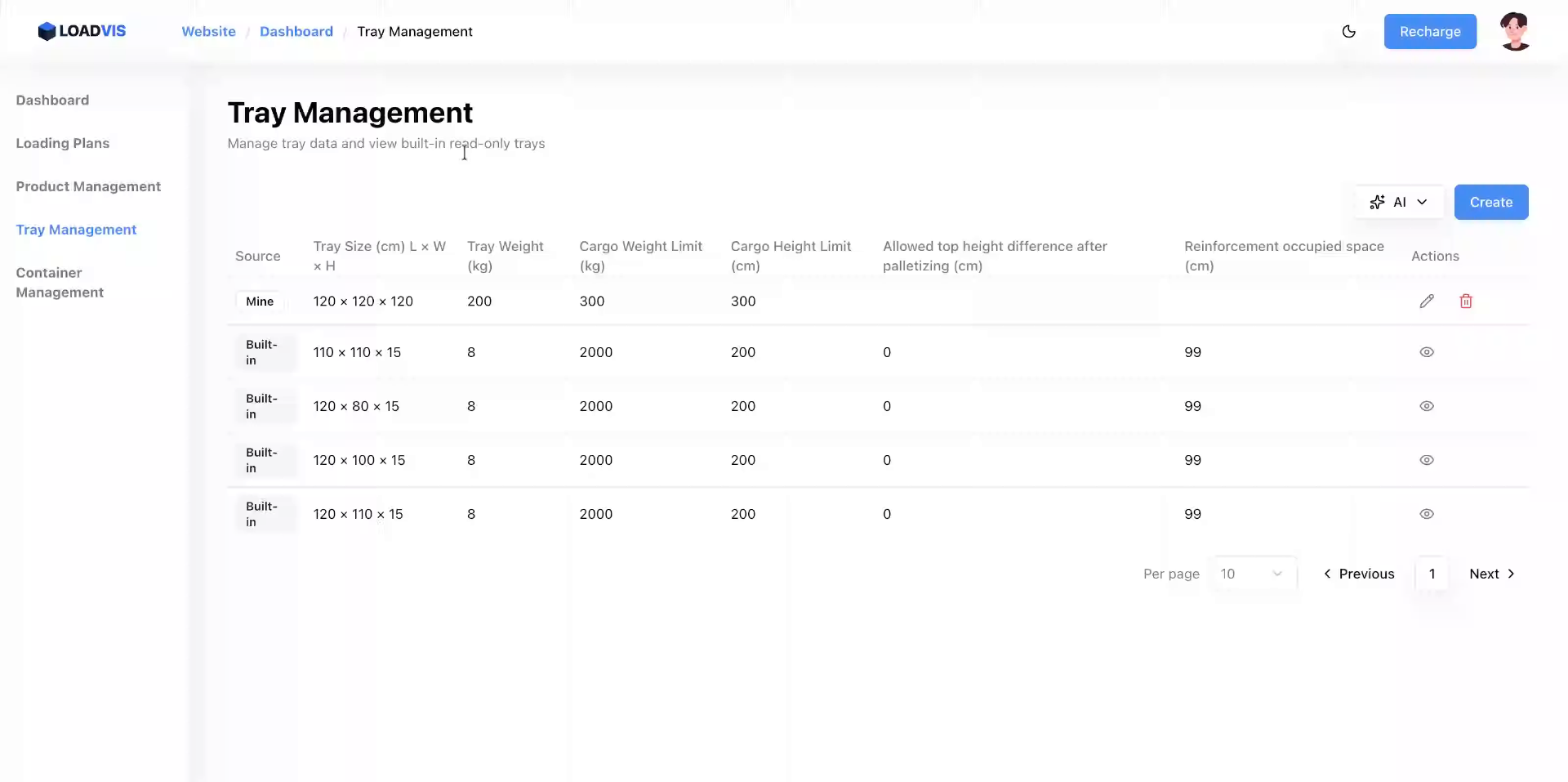
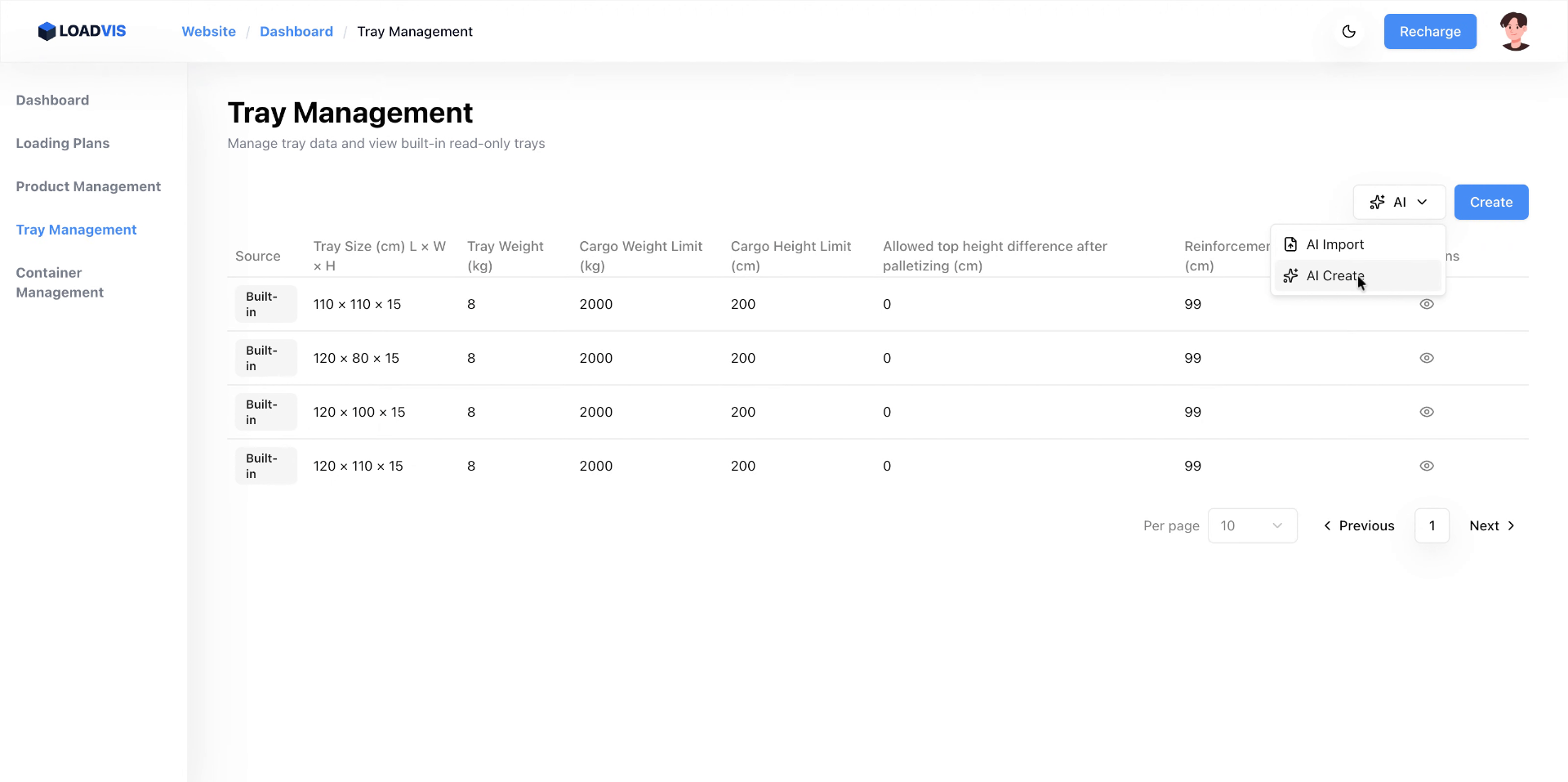
You cannot bypass the structural discipline required to properly feed the system. The AI Creation and Edit workflows demand precise field mapping. First, you must carry out the deliberate entry of tray specification text or paste unstructured supplier documentation directly into the parser interface. The system immediately engages in the automated extraction routine.
Next comes the critical alignment phase. You are required to carry out the conscious mapping of parsed numerical values into highly specific constraint fields. Width, Length, Height, Tray Self-Weight, Max Cargo Load, Cargo Height Limit, and Reinforcement Occupied Space all demand individual cross-referencing. Leaving a single parameter unassigned fractures the logical constraint chain.
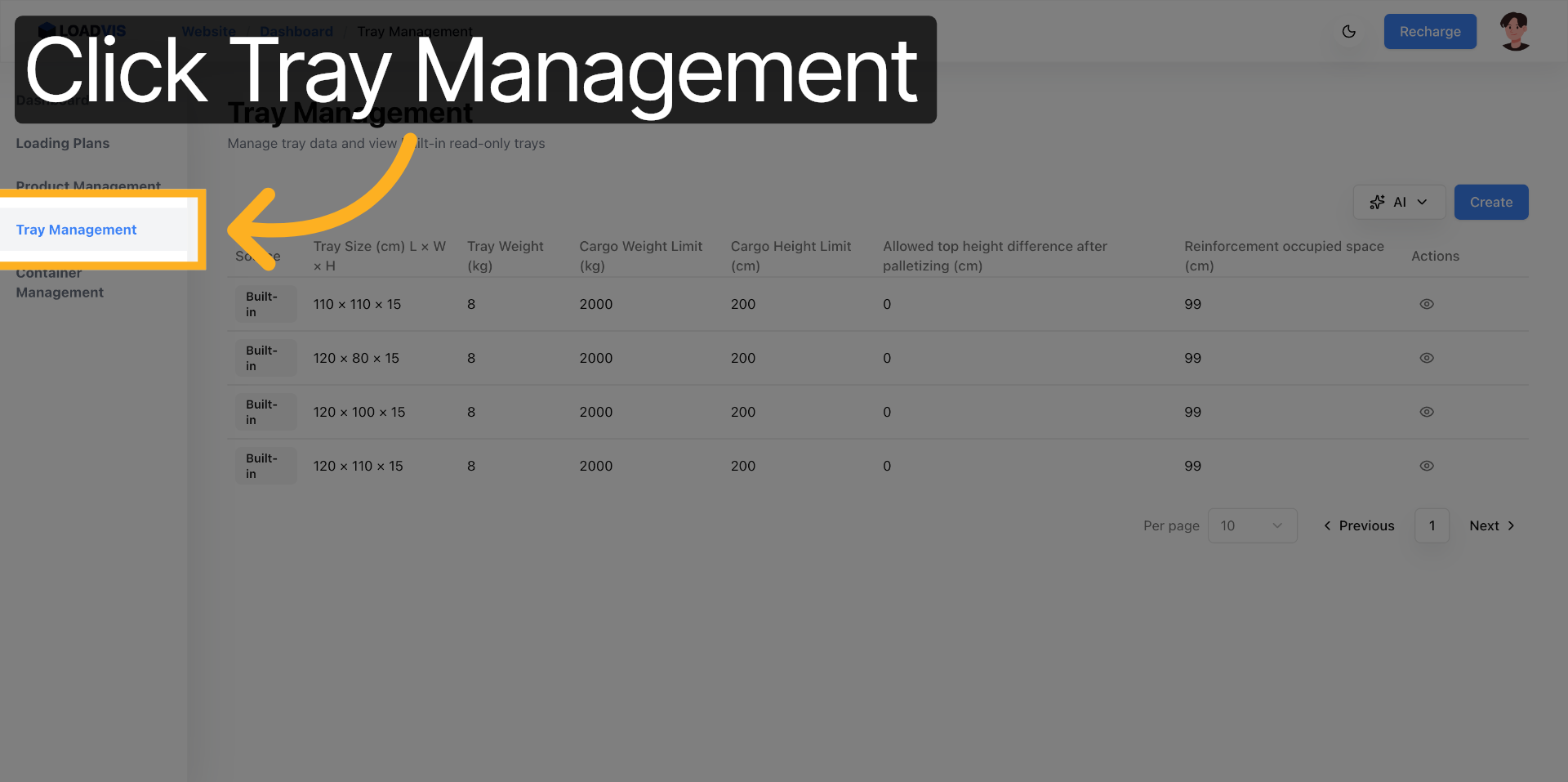
Finally, before initiating any heavy spatial computation, you must engage in a thorough verification pass using the Detail or View panel. You pull up the generated configuration record. You trace every assigned number back to the original procurement document. You confirm the dimensional hierarchy matches reality. Only after completing this inspection do you proceed.
4. Operational Importance Versus Superficial Interface Clicks
Clicking a recognition and storage button requires zero cognitive overhead. It takes roughly half a second. The actual operational weight resides entirely in what you allow to populate those data fields behind the graphical interface.
The AI parser thrives exclusively on unambiguous textual input. You must supply descriptions that cleanly separate base physical footprint dimensions from permissible vertical stacking thresholds. If you deliberately leave the Reinforcement Clearance parameter empty, the computational engine defaults to zero structural constraint. This action completely disables realistic modeling for lashing tension requirements or forklift tine spacing margins. The simulation begins operating in a frictionless mathematical void.
The Max Cargo Load field never functions as a mere decorative numerical entry. It serves as the absolute ceiling for the internal weight distribution matrix. Consider precisely what occurs when tray self-weight goes entirely unrecorded. The calculation pipeline executes assuming a weightless support platform. Net cargo capacity inflates artificially. Legal transport weight thresholds get breached before you even load the first corrugated carton.
You must manually enforce these physical boundaries. The software will never guess your site-specific constraints.
5. The Divergence Between Flawed and Dependable Approaches
Let us examine exactly how teams routinely sabotage their own loading plans. They execute rapid tray creation using the default one-hundred-by-one-hundred-by-one-hundred centimeter template. They blindly equate the supplier's theoretical maximum load rating with a safe operational working load. They ignore top-layer height tolerance completely. Clearance fields remain entirely vacant. They run the spatial solver based purely on raw volumetric ratios. The resulting dashboard looks spectacular until you attempt to physically move the stack.
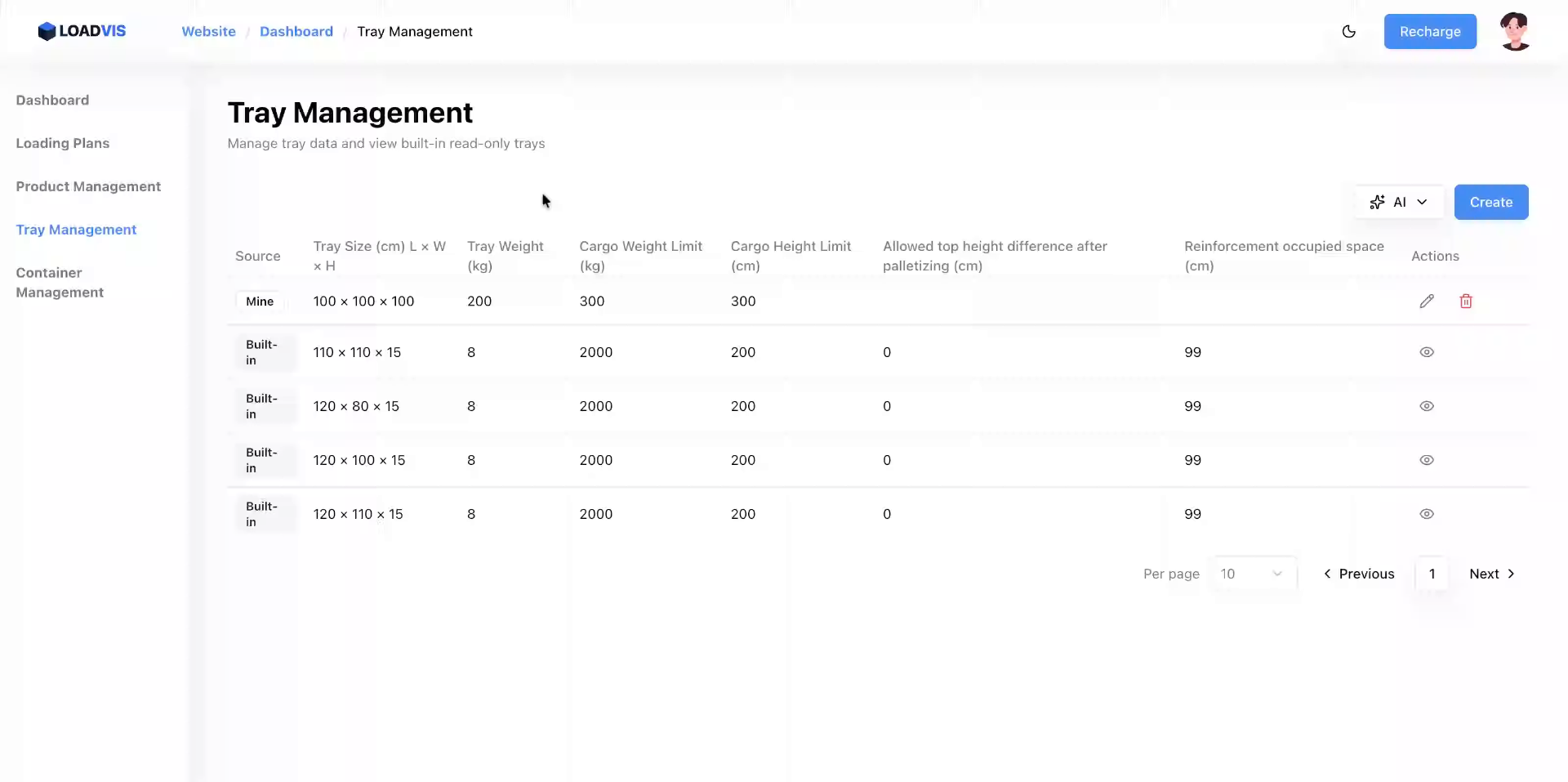
The reliable path requires deliberate procedural friction. You engage the intelligent parsing module with exact supplier specifications. You feed it raw text resembling: "Tray dimensions 120×100×15 cm, tray self-weight 20 kg, maximum cargo load 1,200 kg, maximum cargo height 160 cm, allowable top height tolerance 5 cm." The extraction engine isolates these fragments automatically. You explicitly separate the pallet base height from the allowable vertical stacking height. You define reinforcement clearance whenever polypropylene strapping tension or vertical double-stacking enters the operational scope.
You execute a comprehensive Detail verification routine. You cross-reference the mapped constraint fields against the original procurement contract line items. Only after confirming structural parity do you initiate the solver. The difference does not reside in the computational tool. It lives entirely in your willingness to enforce physical constraints before optimization begins.
6. Tool Capabilities Versus Irreplaceable Manual Verification
The system excels at carrying out the automated extraction of messy, unstructured supplier prose into validated, rigid constraint fields. It enforces strict data type validation rules. It refuses to execute the persistent storage operation for incomplete configuration profiles. It injects those exact numerical limits directly into the three-dimensional packing algorithm and the weight distribution matrix. The spatial solver guarantees perfect mathematical consistency between the input parameters you provide and the volumetric plan it generates.
But the computational environment operates strictly within a digital vacuum. It cannot detect physical tray fatigue resulting from years of repeated forklift tine impacts. It possesses no environmental sensors to measure moisture absorption weight variance during humid coastal storage. It holds absolutely no knowledge regarding your specific warehouse forklift carriage geometry or overhead lighting obstructions.
You must manually carry out the verification process for several highly critical physical variables. You have to carry out an independent determination of whether the recorded Max Cargo Load actually reflects safe working conditions under your specific handling protocols. You need to carry out a careful judgment call regarding whether the Cargo Height Limit adequately accounts for cardboard compression during long-haul transit. You are required to validate that clearance values precisely match the physical operational envelope of your on-site handling equipment.
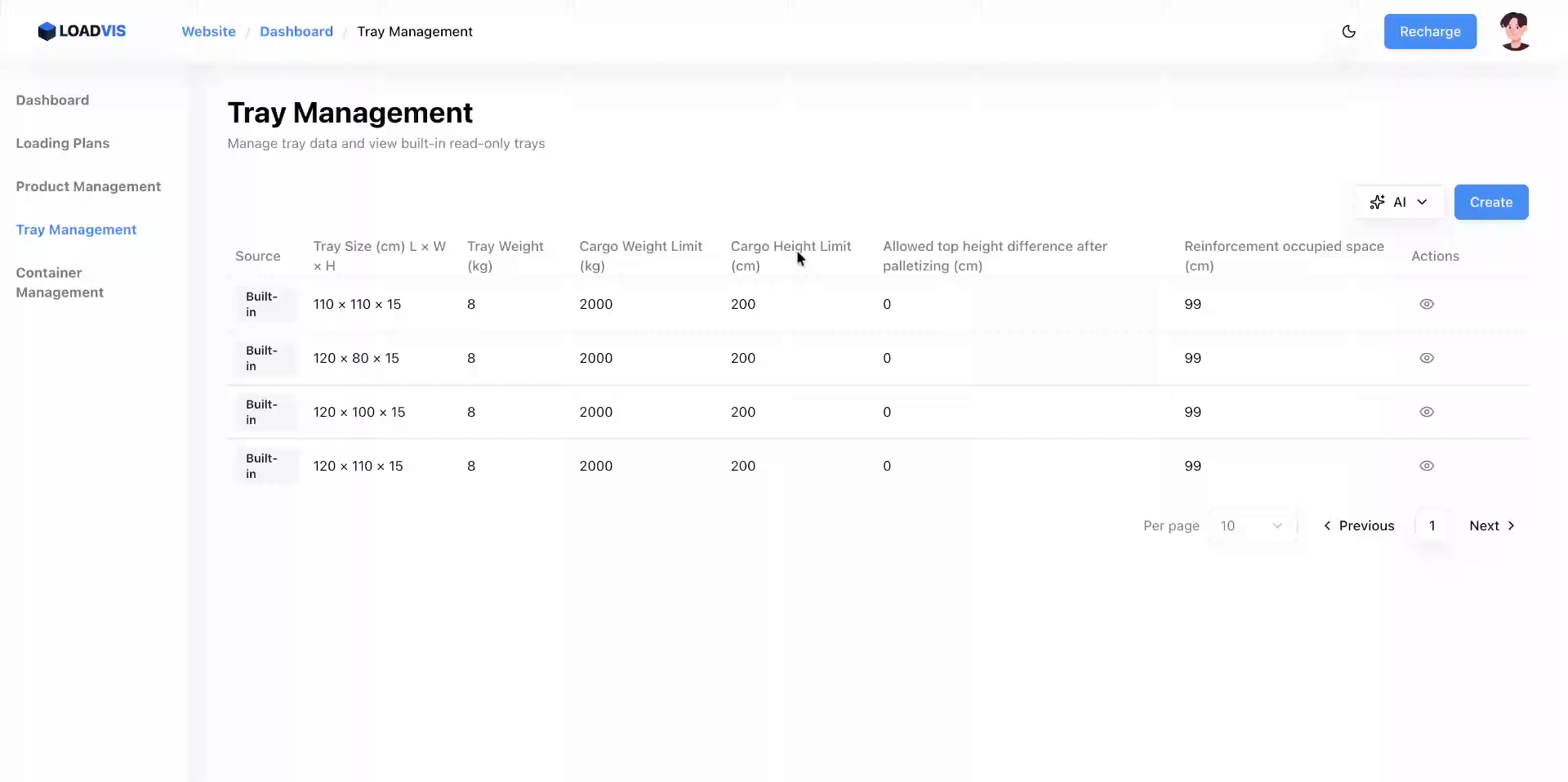
AI text parsing still demands relentless human spot-checking. Always. The mapping engine will process your input text with flawless mechanical accuracy. If that source text contains structural inaccuracies, the resulting digital map leads you directly into operational failure.
7. Constraint Definition Precedes Optimization
Tray configuration fundamentally transcends mundane data entry tasks. It operates as the foundational constraint definition layer. The computational solver can only explore spatial permutations strictly within the physical boundaries you deliberately supply. High-volume utilization plans become genuinely executable on the warehouse floor only when self-weight, vertical height tolerance, and structural clearance undergo accurate digital representation prior to any algorithmic calculation run.
Discipline in parameter mapping systematically eradicates avoidable on-site execution failures. Raw algorithmic sophistication means precisely zero when the underlying data model ignores basic structural physics. Feed the system grounded reality. Watch the generated plans survive direct contact with physical logistics execution.