When 90% Utilization Fails at the Dock: Master Data as Constraint Modeling
1. Scenario and Problem
A forty-foot high-cube container plan returns eighty-eight percent volumetric utilization. The dashboard renders a clean, optimistic metric. You feel a moment of satisfaction. Then the loading crew calls. The bottom layers have deformed. The forklift operator refuses to engage.
We encounter this exact friction point more often than teams care to admit. The root cause rarely resides in the mathematical algorithm. It lives in master data that gets treated as descriptive labeling rather than rigorous constraint modeling. A vendor correspondence delivers a payload containing a single line item: Carton dimensions listed alongside a gross weight figure. An automated parsing engine proceeds to engage in the extraction of those syntactic tokens with flawless precision. But the planning matrix lacks a single directive concerning top-surface load-bearing thresholds. The solver assumes rigid stacking. It proceeds to calculate a three-tier vertical arrangement.
On the warehouse floor, cardboard compresses. Forklift tines cannot safely insert beneath compromised bottom cartons. Unloading devolves into manual breakdown operations. The computational output achieves mathematical elegance. It completely abandons physical execution viability.
2. Why This Problem is Often Underestimated
Planning departments continuously engage in the optimization of container fill rates as a primary performance indicator. They systematically defer physical validation to downstream warehouse operations. Data ingestion tasks get mischaracterized as administrative overhead rather than foundational constraint modeling. When artificial intelligence dramatically accelerates input velocity, it fabricates a quiet illusion of completeness.
Missing constraint fields for maximum stack weight, handling orientation, or pallet type automatically inherit permissive system defaults. The failure mechanism operates in absolute silence. The bin-packing engine runs its routine without issuing a single warning flag. It generates elevated utilization scores. It pushes structural debt directly into the physical loading zone.
The economic reality is brutal. The process of reconstructing a collapsed pallet arrangement at the dispatch bay typically demands tenfold the engineering effort compared to executing pre-plan validation. You are not saving time by skipping the audit. You are merely shifting the labor cost to a higher hourly rate environment.
3. Key Operations and Their Real Importance
The critical workflow does not terminate upon your engagement with the final recognition button. It resides in the immediate audit of three boundary parameters.

Maximum/Minimum Load Capacity: This metric does not function as an informational tag. It acts as the solver's absolute vertical termination condition. When you omit this value, the calculation engine proceeds under the false assumption that you are moving rigid-body components. It will stack plastic crates on corrugated fiberboard until structural collapse occurs. You must carry out the explicit definition of crush limits before releasing any payload.
Pallet Requirement Flag: Activating this particular selection option triggers spatial subtraction logic across the entire calculation canvas. The system proceeds to reserve volumetric real estate for skid geometry. It recalculates centroid distribution across the floor plane. It enforces the mandatory ground clearance required for forklift tine insertion.

Without this explicit marker, the solver treats loose cartons as monolithic blocks. Ground-level access vanishes from the plan. The algorithm optimizes for air space rather than equipment maneuverability.
Dimensional Verification: You must carry out a direct comparison between gross weight and volumetric density as a rapid sanity checkpoint. The extraction pipeline performs purely syntactic analysis. It remains completely blind to material reality. A severe divergence between reported weight and stated volume typically indicates either a manual entry transcription error or a high-density SKU demanding strict anchoring protocols. You have to validate that ratio.
4. Wrong Approach vs. More Reliable Approach
The Wrong Approach: You engage in bulk automated parsing for one hundred fifty distinct SKUs. You immediately initiate the optimization routine. You place complete trust in the volumetric utilization percentage displayed on the header interface. You encounter dock-side rejection within forty-five minutes. The boundary condition analysis remains entirely absent. No weight-bearing thresholds exist. No pallet grouping logic applies. Result: elevated algorithmic scores, physical structural failure, extensive manual rework, delayed dispatch timelines.
The alternative demands deliberate friction.
The More Reliable Approach: You allow the AI engine to generate a preliminary draft text payload. You proceed to export that raw output into a structured list view. You apply category-based fallback configurations across the board. Every fragile electronics unit automatically inherits a strict fifty-kilogram load ceiling alongside an explicit top-load prohibition. You carry out a targeted manual spot-check of high-weight outliers and oversized geometric items. You commit the cleaned records to a reusable product library. You execute the solver with active constraint flags fully engaged.
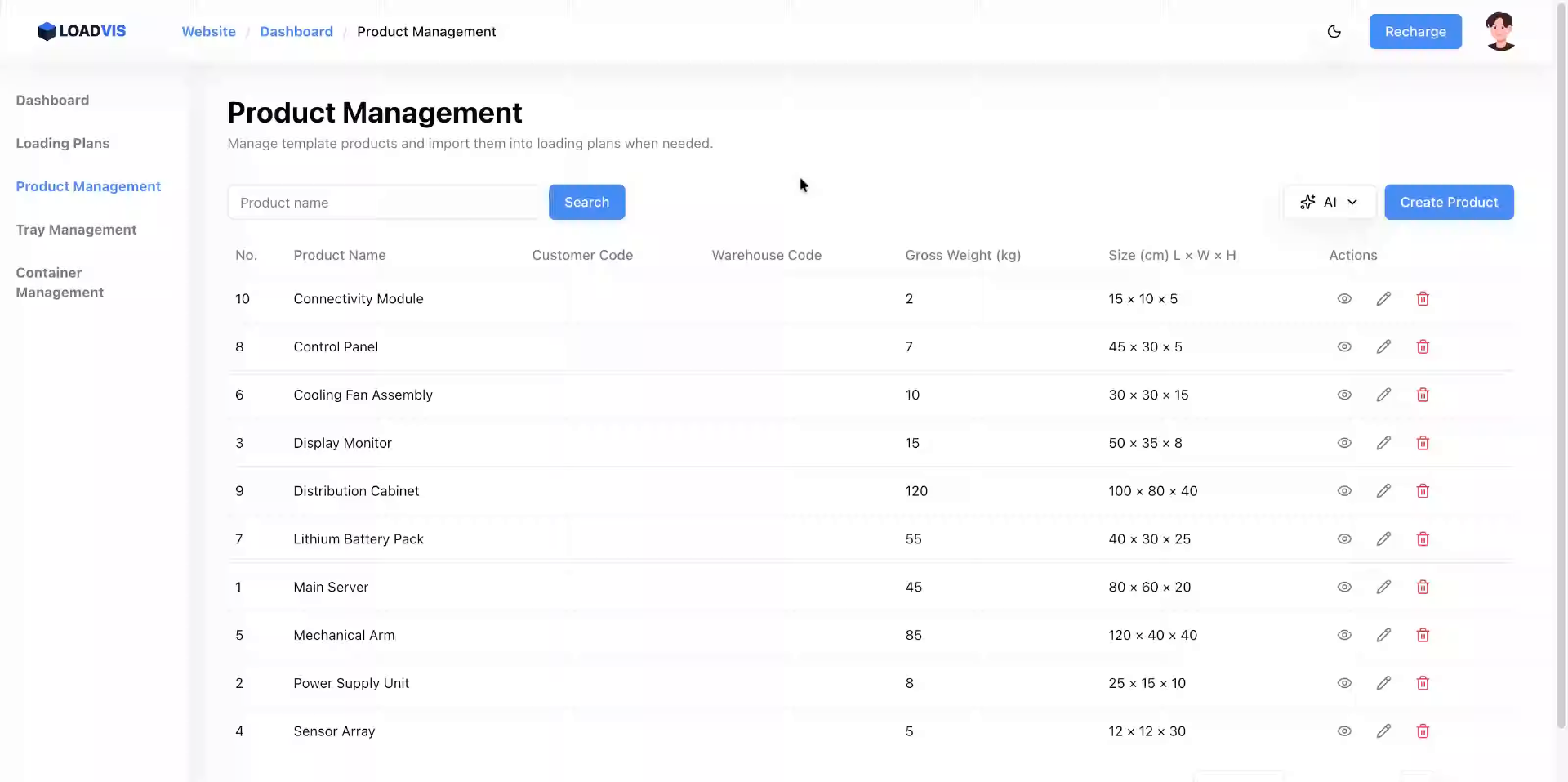
The judgment criteria must remain inflexible. Any SKU that lacks explicit load limitations or pallet classification must remain flagged as a draft artifact. Do not initiate final spatial calculations until constraint field coverage reaches one hundred percent. Compromise that rule, and you voluntarily inherit the operational chaos at the loading ramp.
5. How Far the Tool Can Help & What Still Requires Manual Confirmation
The automated extraction pipeline excels at dimensional parsing routines. It carries out unit normalization across mixed measurement systems. It engages in the bulk formatting of raw payloads with highly predictable accuracy. It translates unstructured natural language fragments into structured database schema fields without introducing parsing friction.
The platform cannot infer material tensile strength from ambient context. It cannot deduce site-specific dock limitations. Those operational boundaries must originate outside the system.
Manual Confirmation Remains Mandatory For:
- Weight-bearing limits: These values must be sourced directly from certified supplier specification sheets or validated internal laboratory stress test data.
- Pallet/Tray geometry: You must manually verify standard versus non-standard configurations, because base spacing fundamentally alters the solver's weight distribution modeling.
- Special handling rules: Forklift entry-side restrictions, environmental sensitivity parameters, or explicit do-not-stack directives require human configuration.
The software delivers the computational substrate. It provides the constraint modeling framework and executes asynchronous solving routines. The planning specialist injects physical reality and defines operational boundaries. Automation reduces data entry latency. Human validation prevents execution failure.
6. Summary
Efficient container loading originates inside the product library. It never begins at the solver dashboard. You must treat AI-assisted data entry as a preliminary drafting layer. It does not constitute a terminal configuration state. You are required to carry out comprehensive constraint validation prior to injecting records into the active planning queue.
Prioritize physical execution viability over theoretical volumetric fill rates. Always. A mathematically optimized cube holds zero practical value when it fractures during routine material handling. Construct reliable plans on verified operational boundaries. Do not settle for optimized empty space.