Ninety-two percent volume utilization. That is the number the planning dashboard flashes. A mathematically elegant, perfectly tessellated matrix.
It fails on the concrete.
A standard 20OT container sits at the bay. The forklift approaches. The top tier of the calculated stack catches the upper crossbar. Three centimeters of clearance in the digital twin vanish against a warped door gasket and localized structural fatigue. The plan halts. You cannot load what physically cannot clear the aperture. The algorithm never experienced the friction. It optimized for a pristine void.
Why do we consistently underestimate this mechanical reality? Planners treat ISO dimension sheets as immutable gospel. They forget that these steel boxes operate in a continuous degradation cycle. They accumulate floor panel bowing, internal ribbing offsets, and rust-induced dimensional shrinkage. Teams prioritize volumetric arithmetic while completely ignoring kinematic access envelopes. The solver converges on a theoretical maximum. It crashes against actual door clearance limits. It ignores payload distribution thresholds.
We must carry out management of the physical constraints before the solver ever begins its calculation cycle. The workspace does not guess. It respects exactly what you tell it to respect.
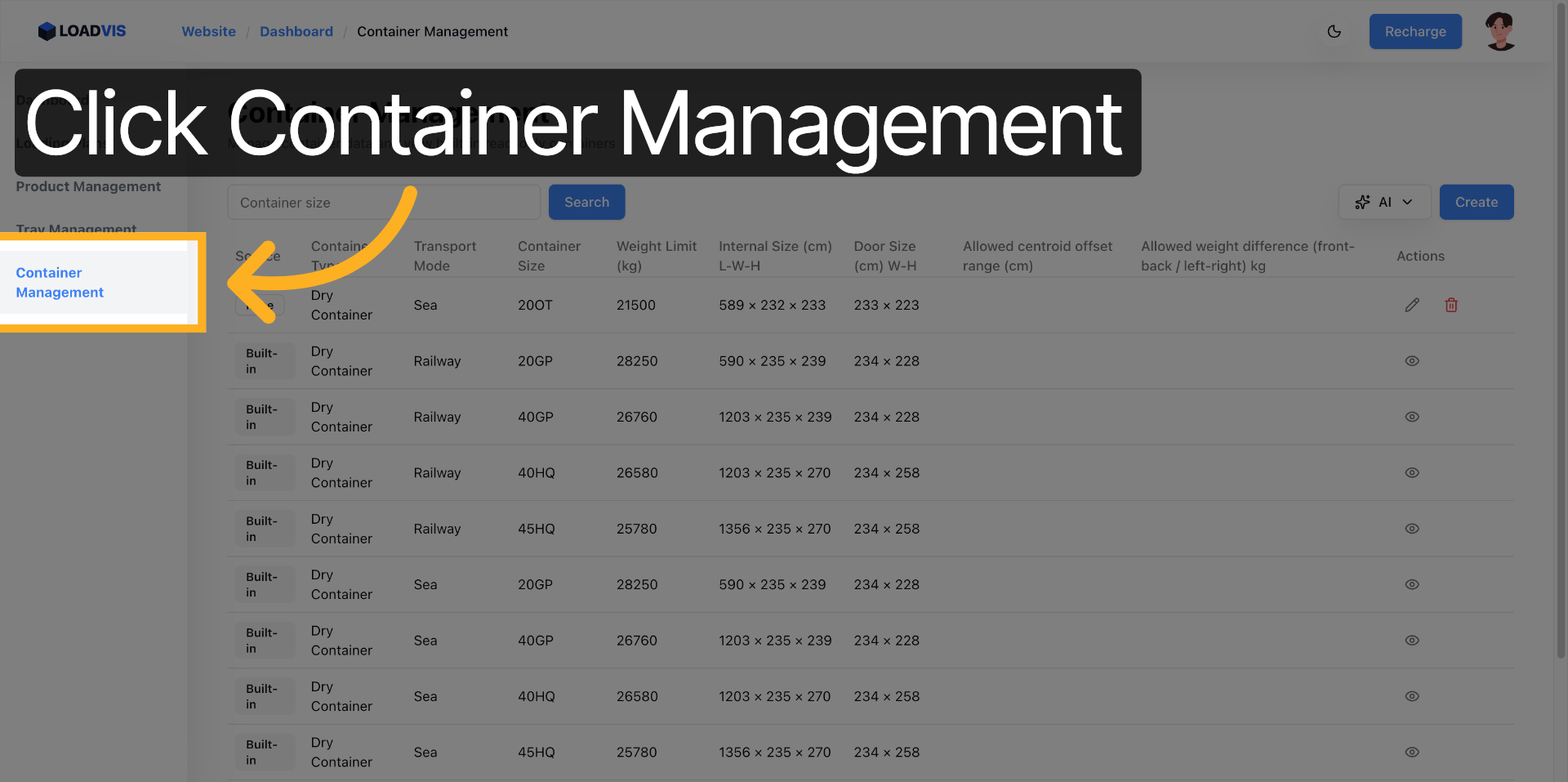
We begin by opening the configuration interface. You will proceed to carry out access to the container management module by initiating the designated navigation path. The system displays the existing repository.
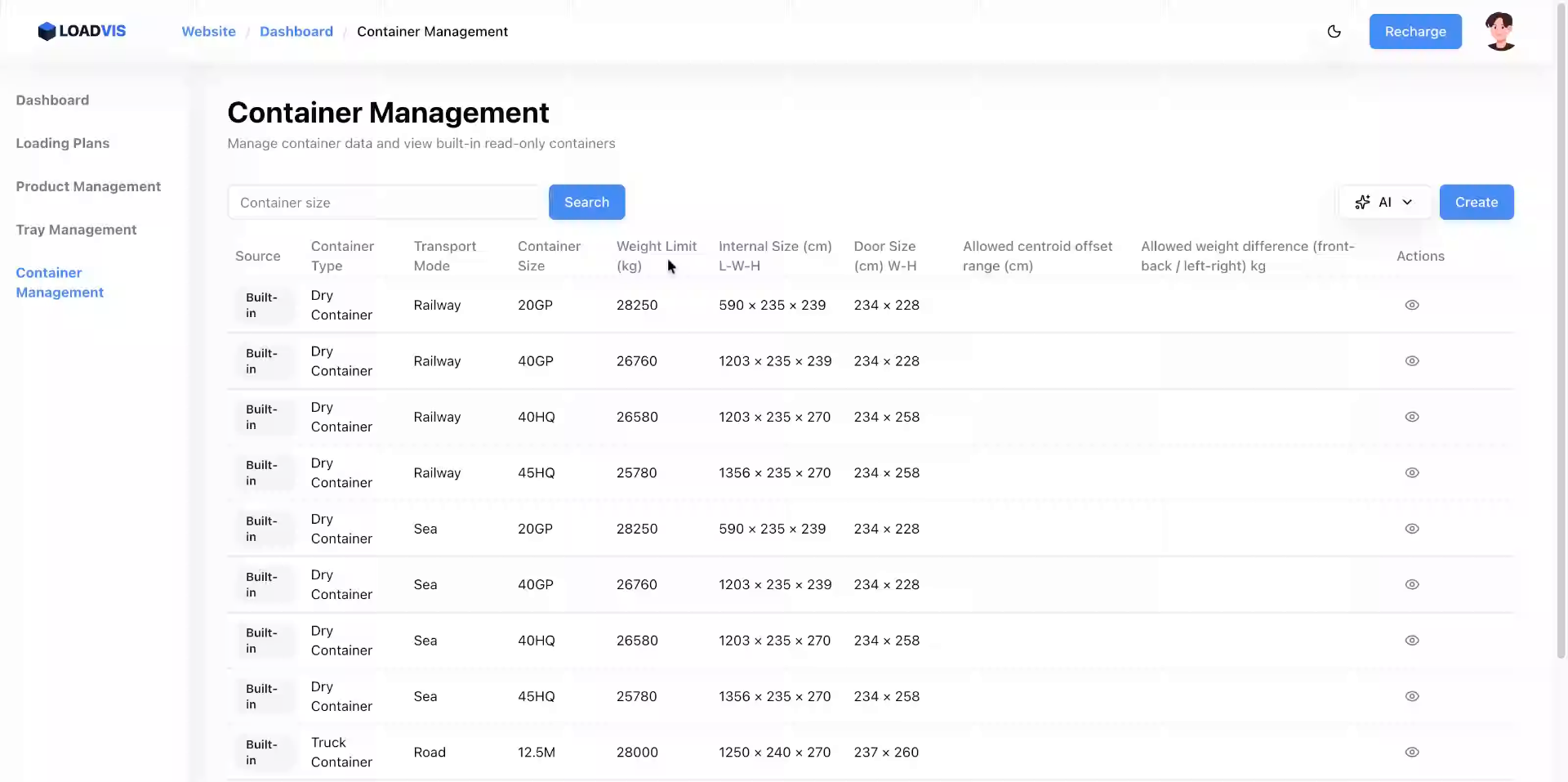
Instead of manually typing every integer, we engage in the process of automated data structuring. You will carry out activation of the AI Creation feature. The recognition engine begins to perform parsing of raw specification strings. It ingests fragmented carrier notes. It extracts dimensional tokens.
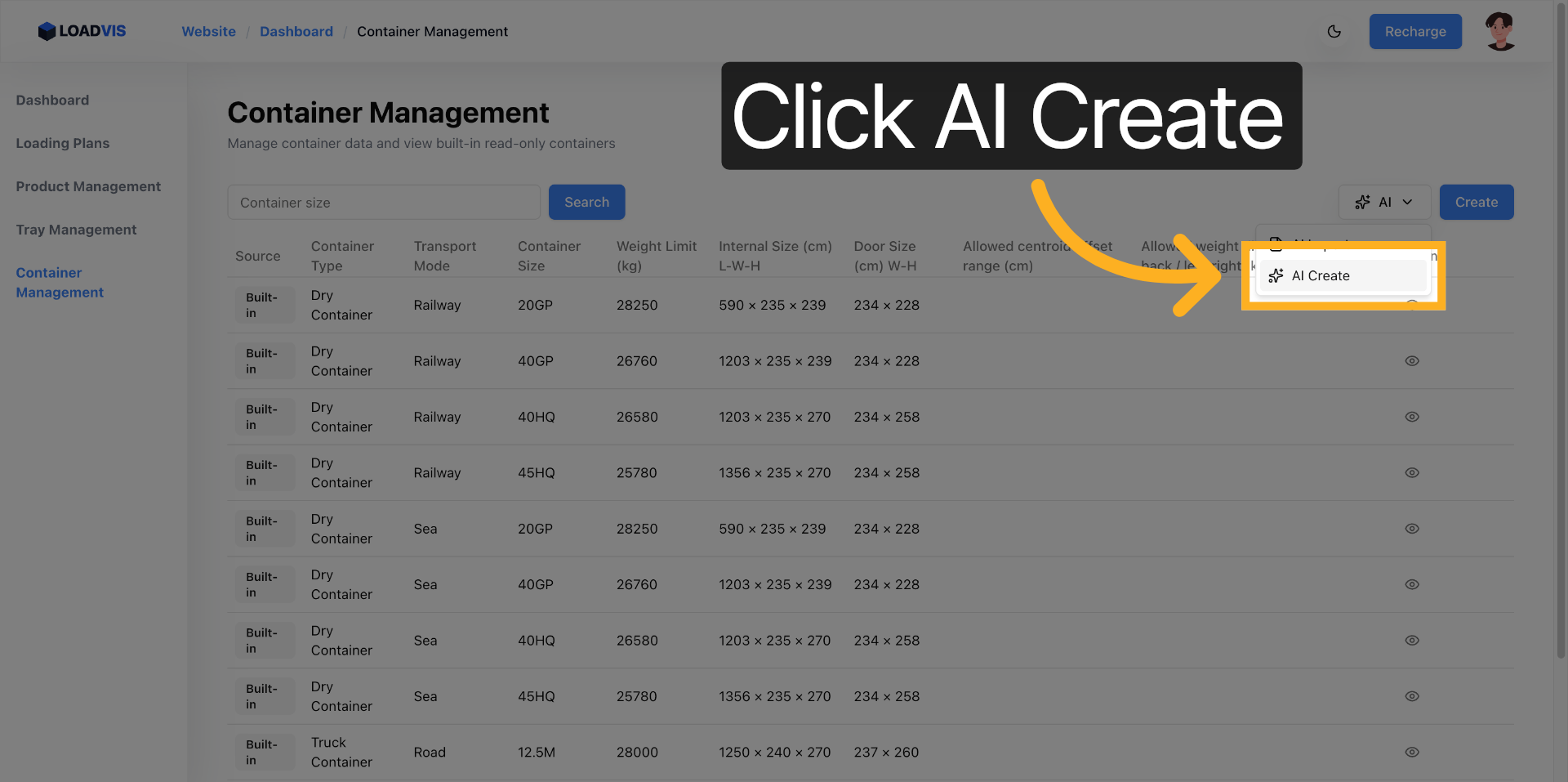
You input a block of text. "20OT Max Weight: 21,500 kg Internal Dimensions: 589×232×233 cm Door Opening: 233×223 cm". The system carries out mapping of these values into the underlying schema. It translates unstructured carrier documentation into structured constraint fields.
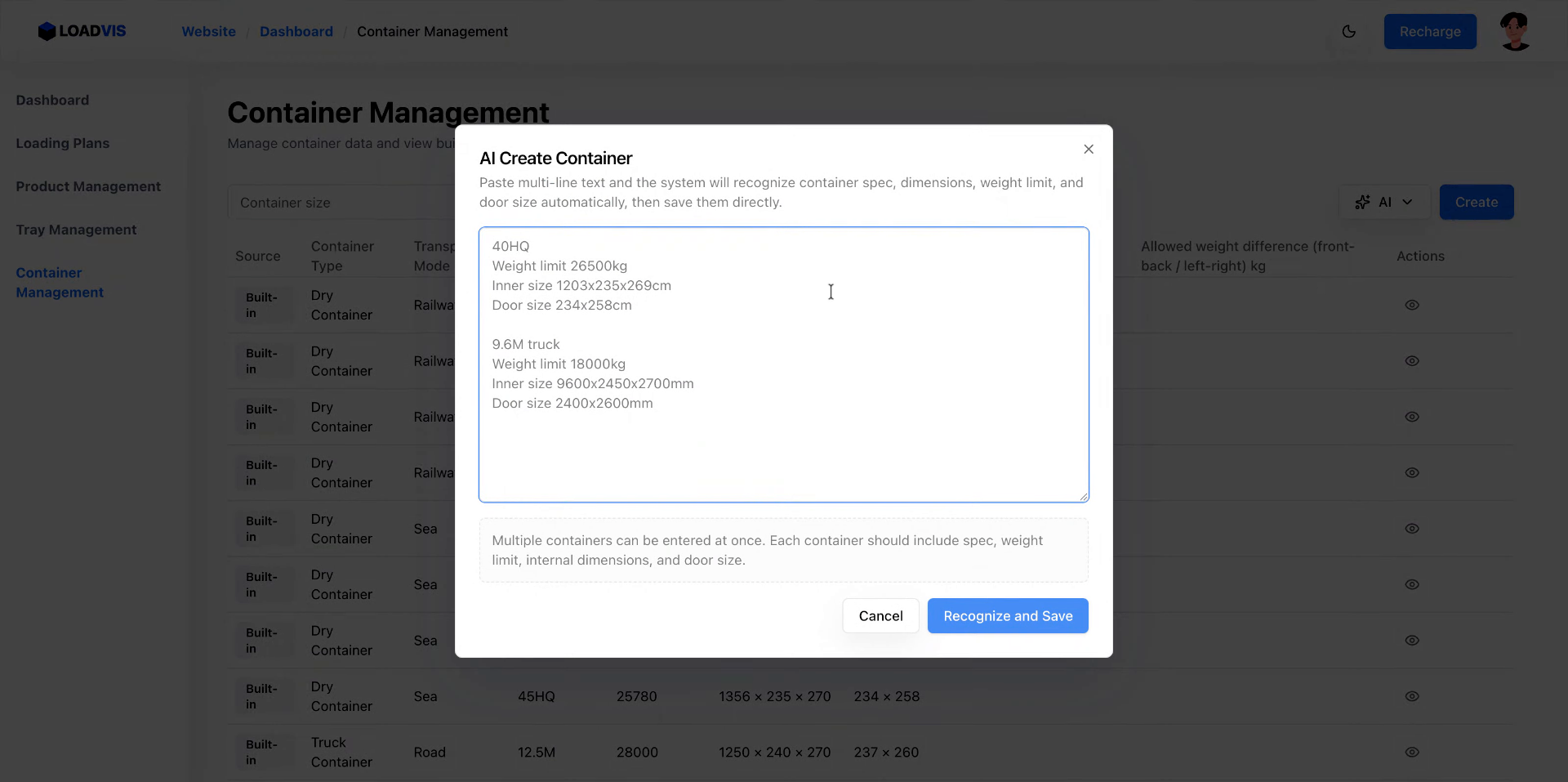
This step establishes the hard boundary for the packing algorithm. But here lies the critical operational divergence. Automation handles data ingestion. It does not perform physical validation. You must carry out manual adjustment of the door opening height and the maximum payload threshold.
Consider the payload parameter. A default implementation accepts the manufacturer’s gross rating. The optimization engine happily stacks dense SKUs until it strikes that numerical ceiling. The reality on the dock diverges. Local highway axle limits. Tare weight variances. We must carry out reduction of the theoretical maximum capacity. You will clear the pre-filled value. You will input a conservative operational buffer.
And the door.
The door opening height dictates the maximum vertical reach of your material handling equipment. If the template assumes a pristine 233 cm aperture, and the actual fleet features a lowered reinforcement bar or a damaged latch mechanism, the entire loading sequence stalls. You will need to perform manual overriding of these geometric parameters. You will carry out entry of the measured as-built clearance. You will execute a verified save operation to persist the updated constraints.
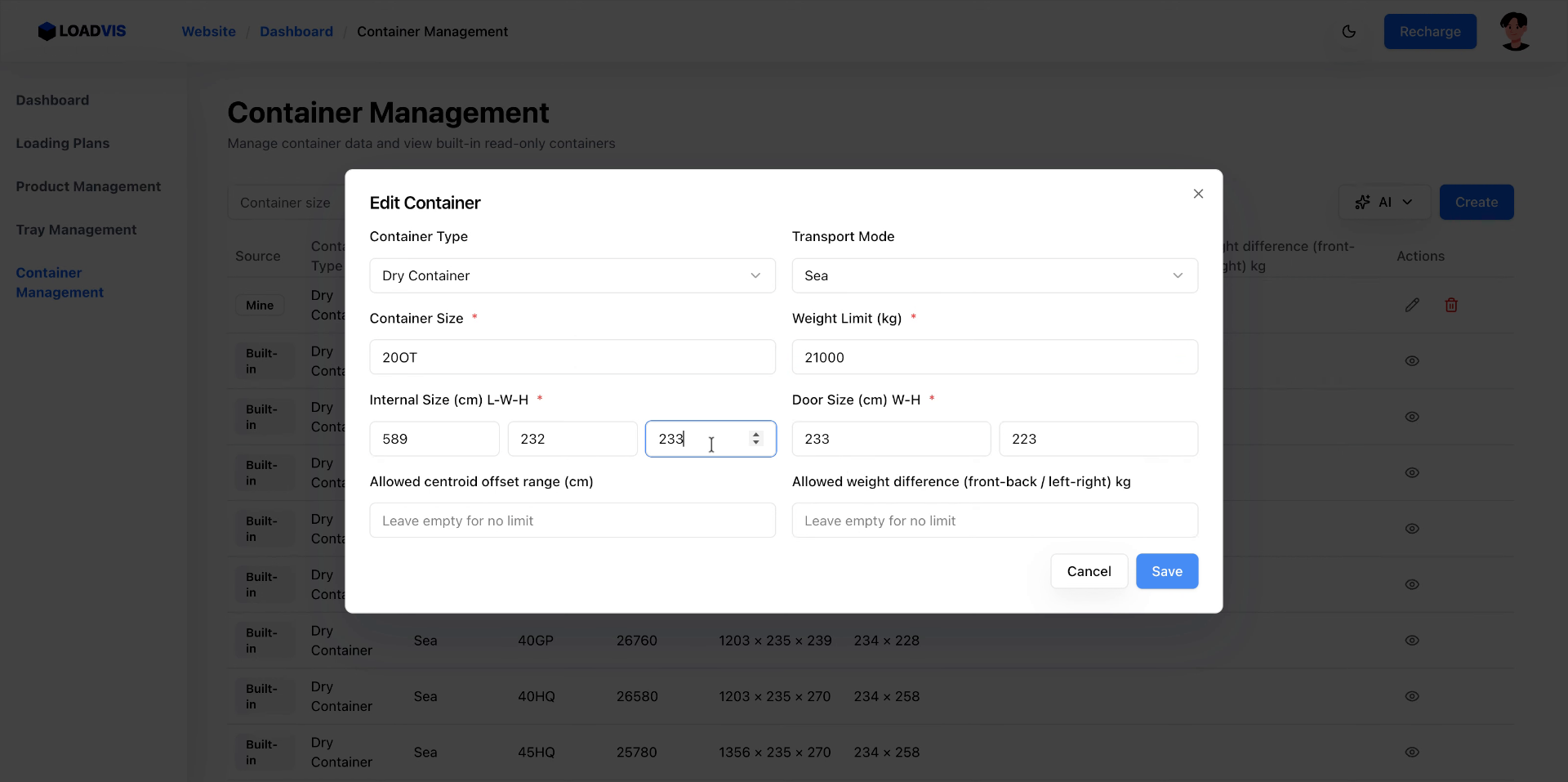
The solver now respects these hard stops. It stops pushing items into spatial impossibilities. It prevents algorithmic over-optimization. The list refreshes. The new entry reflects reality, not a brochure.
Let us draw a definitive line between fragile planning and resilient execution. The flawed methodology relies on generic presets. It trusts theoretical maximum weights. It assumes a frictionless loading bay. It produces high fill rates. It guarantees dockside rejections.
The reliable approach discards textbook assumptions. It relies on measured as-is clearances. It incorporates structural deformation buffers. It treats the door aperture as a physical choke point. The output might display an eighty-five percent fill rate. It arrives at the destination intact.
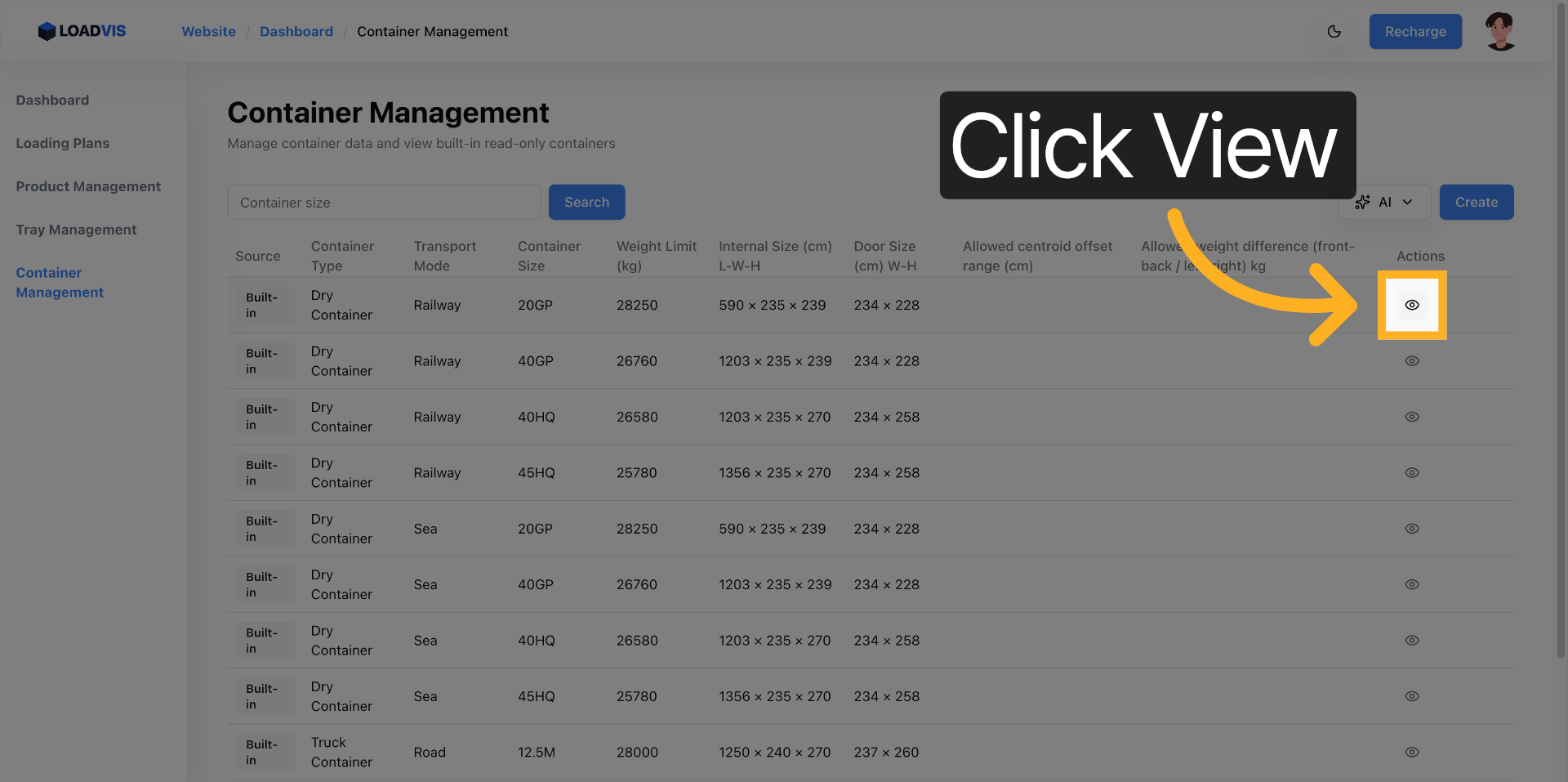
When you browse the repository, you are observing the cumulative result of these decisions. You will carry out execution of filter conditions by expanding the container size panel. You will input the target dimension identifier. The system performs retrieval of matching records. You inspect the detailed parameter sets. You verify that the stored integers match the physical asset, not the theoretical standard.
Where does the computational framework end? Where does human judgment begin?
The AI recognition and templating system accelerates the structuring of constraint-aware solving. It carries out rapid evaluation of millions of placement permutations against your defined geometric boundaries. It handles the combinatorial complexity.
But the machine cannot walk the yard.
It cannot account for carrier-specific axle weight distribution mandates. It cannot measure the turning radius degradation of your specific electric forklift on a worn, uneven concrete surface. It cannot anticipate a customs seal hanging from the upper header, reducing clearance by an additional four centimeters. These parameters demand human confirmation. You must carry out physical measurement verification. You must engage in cross-departmental alignment with the logistics operators on the ground. The tool provides the mathematical framework. You provide the operational truth.
How do you judge if a template is ready for production deployment? Run a rigid triage.
Does the configured door height subtract at least five centimeters for latch protrusion and frame tolerance? If not, the template fails validation. Does the payload cap include a minimum ten percent buffer for unexpected tare weight variance and pallet height inconsistency? If not, the template fails validation. Are the internal dimensions adjusted for internal wall ribbing that reduces usable depth by more than eight percent? If not, the template fails validation.
Only when these conditions pass does the template enter the calculation queue.
High utilization rates remain a mathematical illusion without rigorous boundary enforcement. The loading plan must survive contact with the physical world. We do not optimize for perfect geometric cubes. We optimize for executable, error-resilient sequences. Define the edges. Restrict the solver. Leave adequate spatial tolerance for the inevitable imperfections of the warehouse floor. Then, and only then, does the plan transition from screen validation to actual steel loading.