The Door-Clearance Gap: Why High-Volume Plans Fail at the Container Entrance
1. The Scenario and the Problem
A loading algorithm outputs a ninety-four percent volume utilization metric. The dashboard renders an immaculate spatial layout. You forward the digital blueprint to the terminal. Execution stalls abruptly by the third pallet layer. The forklift mast collides, quite violently, with the upper structural hinge of the container doorway. Or the weighbridge flashes red, signaling a chassis overload the calculation engine entirely ignored. Why does the arithmetic fracture precisely at the physical threshold? It is, in fact, rarely a floating-point discrepancy. The root cause invariably traces back to a boundary condition mismatch between idealized container profiles and actual physical reality.
2. Why This Is Underestimated
Planning teams naturally tend to carry out volumetric optimization routines. They habitually treat container specifications as static library defaults. In practice, that assumption fractures immediately upon contact with operational reality. Door clearances quietly contract over extended cycles due to rubber seal compression, mechanical hinge fatigue, and the gradual accumulation of interior coating material. Usable ingress height typically shrinks by one to three centimeters. Maximum payload exhibits identical instability. It fluctuates continuously according to manufacturer batch tolerances, chassis tare-weight deviations, and the aging schedules maintained by carrier fleets. Deviations of three hundred to eight hundred kilograms from published averages remain entirely standard. The solver will happily proceed to occupy the modeled space. It cannot, however, automatically compensate for unconfigured physical bottlenecks. You feed it geometric abstractions. It returns geometric abstractions. Reality, unfortunately, deals exclusively in millimeters and structural yield points.
3. Key Operations and Their Operational Weight
Let us examine the actual configuration sequence. The interface does not merely exist to accelerate data input. It functions, fundamentally, as a constraint definition matrix.
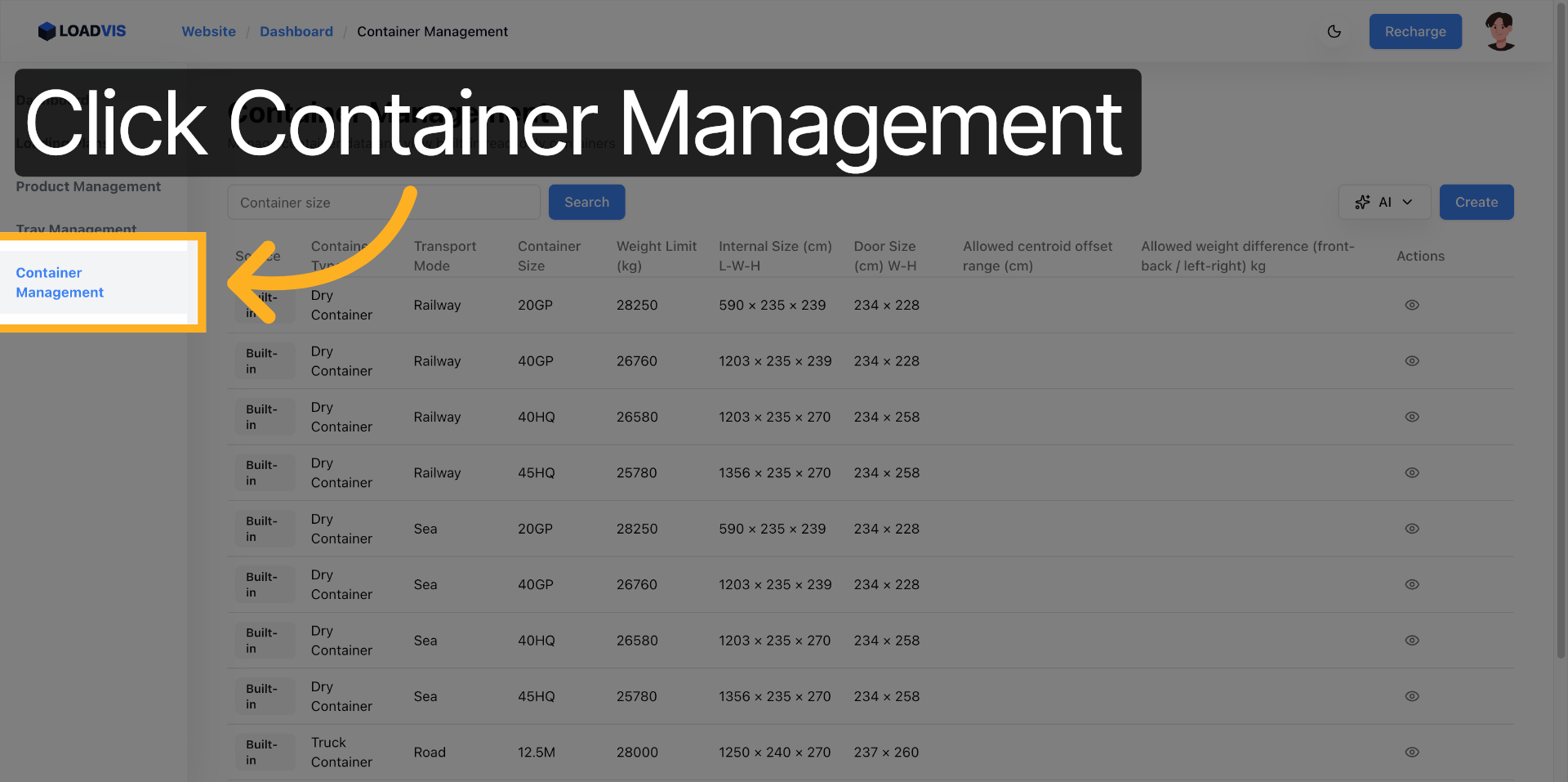
You begin by proceeding toward and activating the Container Management workspace.
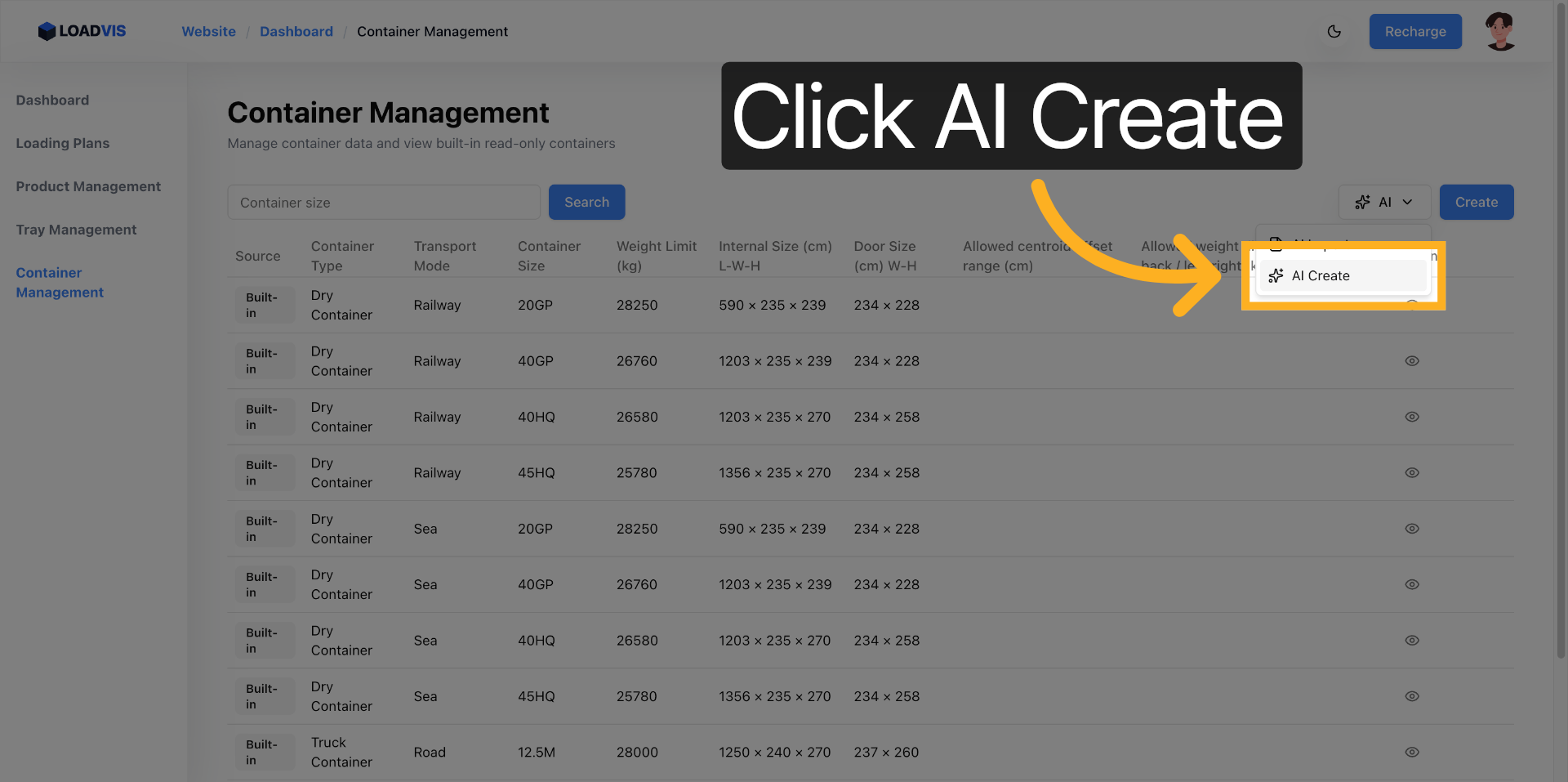
 Following that initial step, you proceed to engage in the invocation of the built-in recognition module.
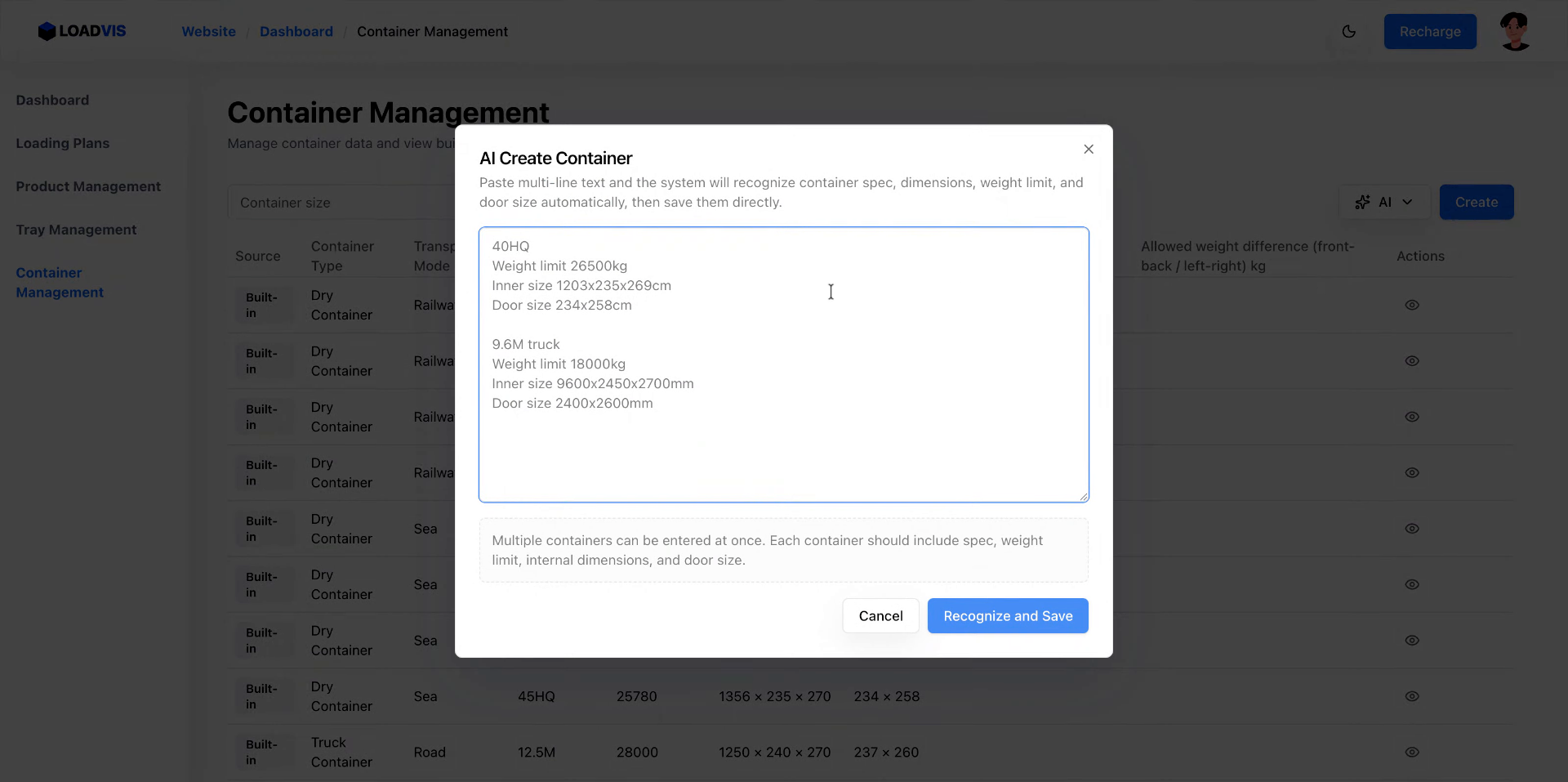
 You paste raw carrier specification text directly into the designated input buffer. Something resembling
 20OT Max Weight: 21,500 kg Internal Dimensions: 589×232×233 cm Door Opening: 233×223 cm. The parsing engine automatically proceeds to map the measurement units and subsequently populates the corresponding schema fields.
 Here is where operational discipline strictly separates functional plans from expensive delays. You must, without exception, undertake the manual cross-examination of the Door Height, Door Width, and Maximum Payload parameters against the physical equipment certificate or the visible pool decal. The numerical values, which you ultimately commit to the system interface, are not merely decorative metadata. They operate as hard solver constraints. When you execute the persistence operation, you effectively establish immutable stackability boundaries, pallet overhang limitations, and axle load distribution parameters across the entire routing network.
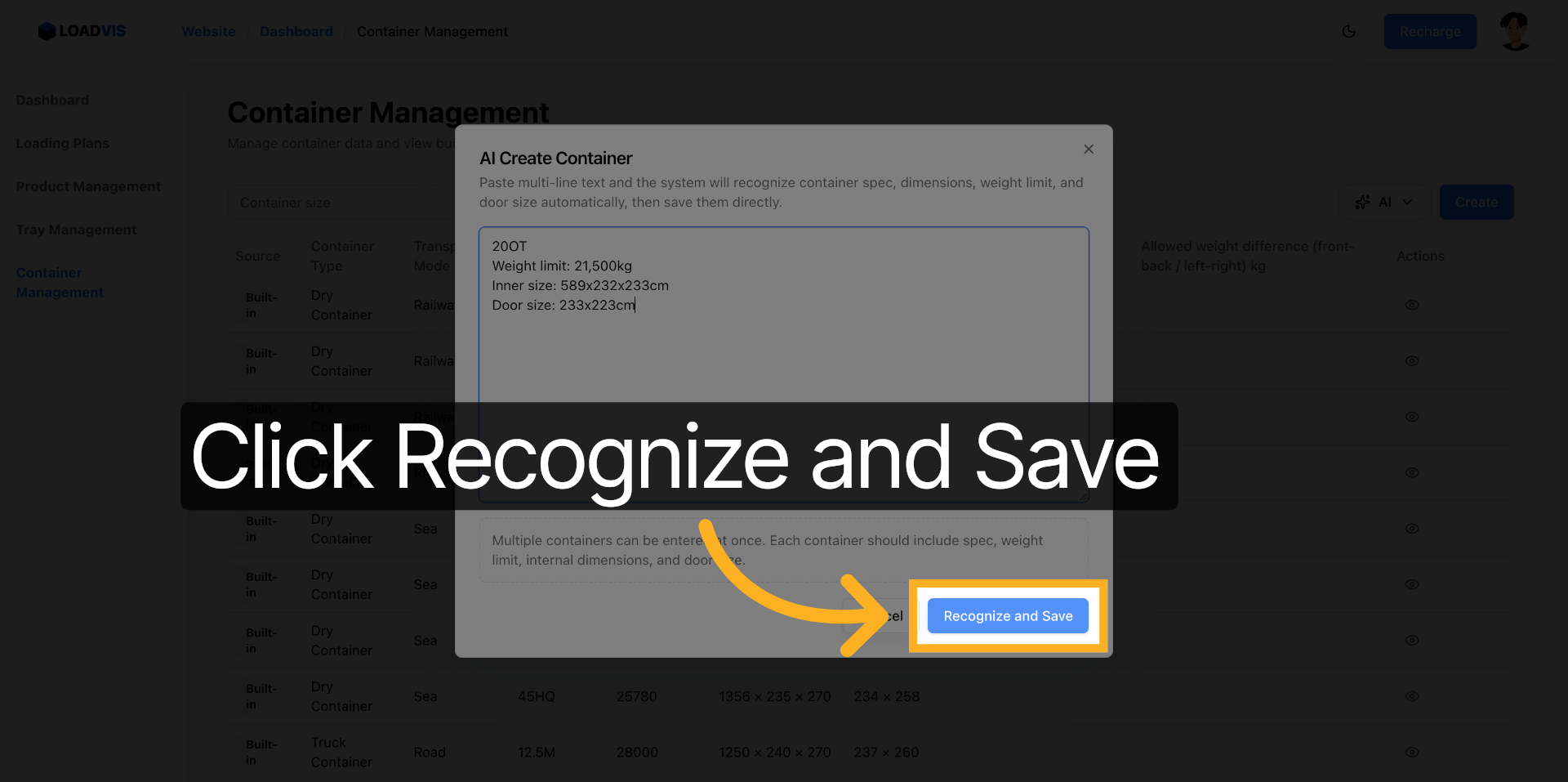 The input forms appear as standard form elements. They are mathematical guardrails. Treat them accordingly.
4. Wrong Approach vs. Reliable Approach
The operational divergence becomes stark when you compare habitual data entry against validated configuration workflows.
| Dimension | Wrong Approach | More Reliable Approach |
|---|---|---|
| Container Template | Engage in the routine reliance on preset generic classifications; leave door clearance parameters completely null or set to theoretical maximums. | Extract precise measurements directly from specific carrier pool manifests. Apply a mandatory one to two centimeter operational buffer for structural deformation. |
| Weight Parameter | Input aggregate gross tonnage values or consistently disregard tare-weight variances; assume uniform load-bearing capacities across all units. | Calculate net rated payload by deducting documented tare weight from maximum gross weight. Apply conservative downward adjustments for high-cycle inventory or heavy-duty site equipment. |
| AI Utilization | Accept machine-transcribed outputs without independently conducting unit verification between metric and imperial standards. | Employ the parser strictly for initial data drafting, then manually audit threshold mappings prior to system persistence. Treat the recognition layer as a transcription utility, not a definitive authority. |
| Outcome | Digital blueprint achieves mathematical perfection; physical execution triggers immediate dockside rework, detention charges, or safety compliance violations. | Operational plan respects actual ingress geometry and structural stress tolerances; field execution mirrors digital projection with minimal deviation. |
5. How Far the Tool Can Help vs. Manual Confirmation
Where exactly does the software architecture terminate and human judgment commence? The platform excels at executing unstructured document ingestion routines. It enforces strict unit harmonization protocols across disparate measurement standards. It actively proceeds to prevent the persistence routine whenever critical boundary fields remain unpopulated. It maintains version-controlled container registries alongside complete audit trails. It guarantees the optimization kernel never attempts to run calculations against undefined parameters. It lacks tactile perception. The system cannot undertake physical inspections for hinge corrosion or floorboard warping. It will not, under any circumstance, measure your local terminal forklift mast clearance against the container sill. It does not automatically account for sudden seasonal carrier policy shifts or port-specific draft restrictions. You must personally perform the final validation pass. You need to apply conservative payload reductions based on fleet utilization history. You remain the sole entity responsible for signing off on configuration accuracy before triggering the solver. The tool prepares the computational environment. You still have to inspect the actual hardware.
6. Summary
Container definitions are not administrative paperwork. They constitute the rigid geometric and kinetic boundaries of the optimization engine. When you engage in the precise configuration of door clearance and payload limits, you transition from chasing abstract volume metrics to generating executable field plans. The parsing utility removes formatting friction. Human verification of site-specific tolerances remains the only viable mechanism for preventing execution failure. Verify the edges. Ship the rest.