AI Product Entry & The Hidden Cost of Missing Handling Constraints
We have all been there. You receive an unstructured freight manifest via email. You dump it into a parser. The system will swiftly carry out bulk text parsing operations on the raw string data. SKU identifiers, quantity counts, L×W×H spatial metrics. Everything flows into the database. You click run. The optimization engine consumes the inputs. It spits out a 94% theoretical volume occupancy rate. You feel a brief surge of satisfaction. Until the dock supervisor calls.
The math works. The physics do not.
Heavy machinery gets positioned directly atop fragile corrugated cartons. Palletized footprints completely obstruct designated forklift maneuvering lanes. Container door clearance thresholds get entirely ignored by the sequence logic. You stare at a perfectly optimized stowage topology. It looks brilliant on the monitor. It collapses under actual weight distribution rules on the asphalt. We are dealing with a fundamental disconnect between cubic occupancy metrics and on-site mechanical realities. The plan is mathematically dense. Physically unexecutable.
Why does this keep happening? Commercial procurement documents prioritize billing dimensions. They list quantities. They completely ignore stress vectors. Physical constraints live elsewhere. Warehouse standard operating procedures. Supplier margin notes. Legacy compliance sheets. The extraction engine naturally gravitates toward explicit numerical fields. When it encounters ambiguity, it applies conservative, neutral defaults to resolve the uncertainty. Planners frequently operate under the assumption that volumetric compatibility equals shipping readiness. Dangerous assumption. Real-world cargo loading operates entirely on stress distribution principles. It relies on centroid stability calculations. Mechanical handling limits dictate the sequence, not geometric volume algorithms. When you feed an optimization engine raw spatial data without physical boundary conditions, you are essentially asking it to perform structural balancing with concrete blocks.
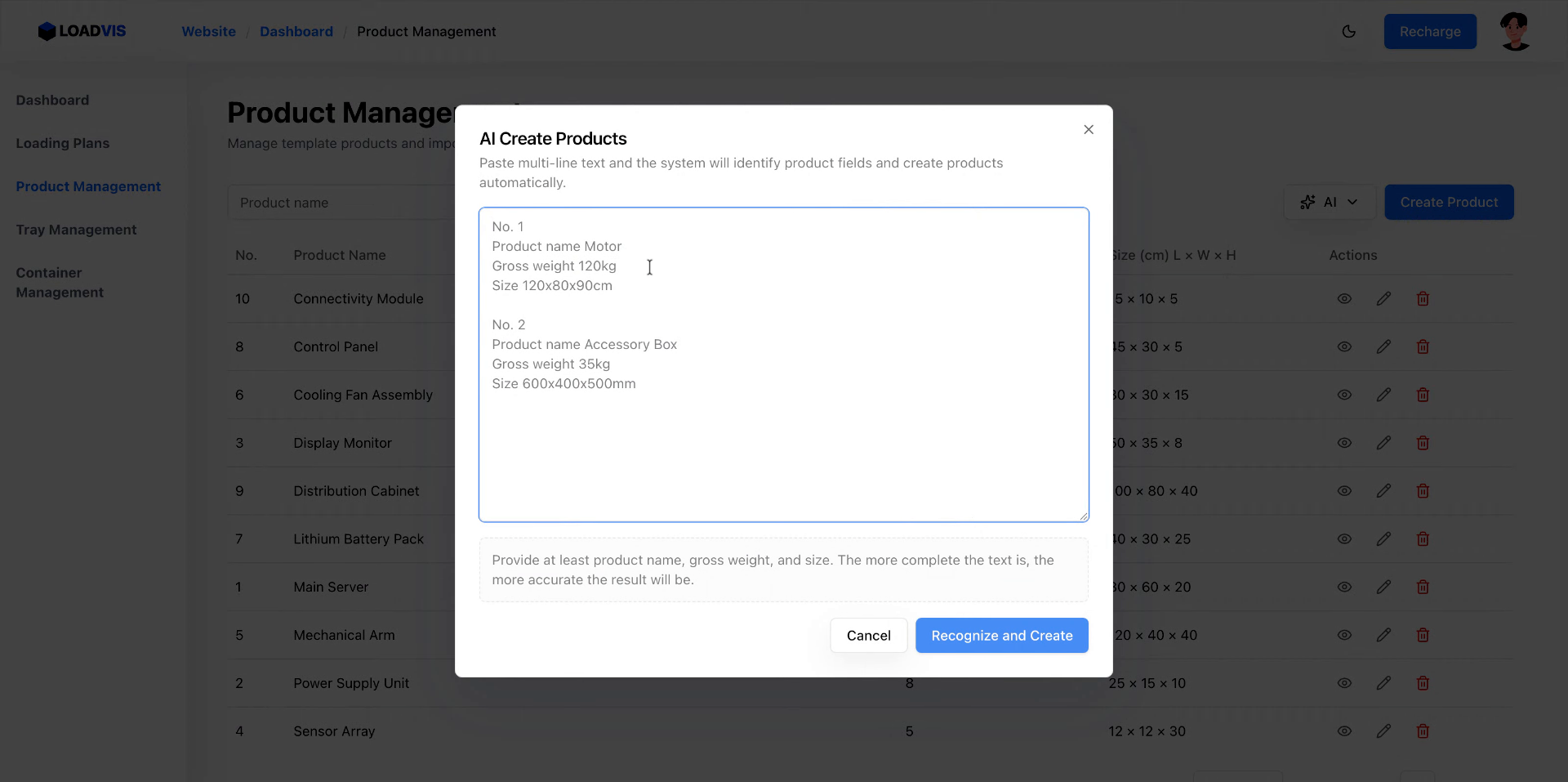
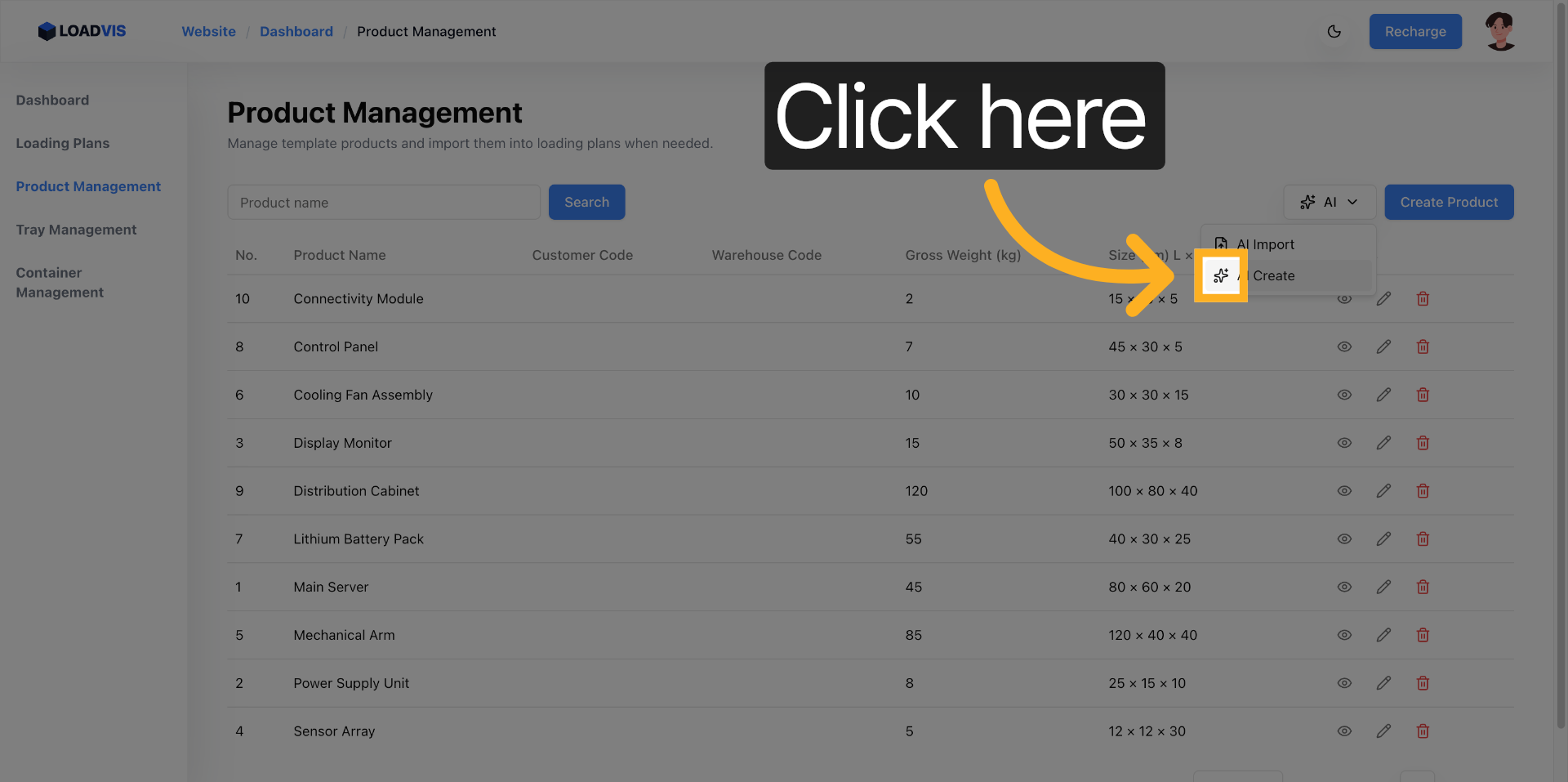
Let us examine the actual execution pathways. You initiate the AI Create workflow. The system will carry out a comprehensive textual sweep across your input block. AI Create Step 4-5 dictates that the parser will execute extraction routines to isolate SKU names, aggregate quantity counts, and capture dimensional parameters, subsequently performing the database persistence operations on those structured rows. Fast. Frictionless.
But you must pivot your workflow immediately. Navigate toward the Create/Edit module. Locate the Maximum Load Capacity and Minimum Load Capacity fields. Carry out the manual toggling of the Pallet Requirement flag. Create/Edit Step 6-7 & 8 are not mere form fields to bypass. They constitute the algorithmic physical boundary conditions.
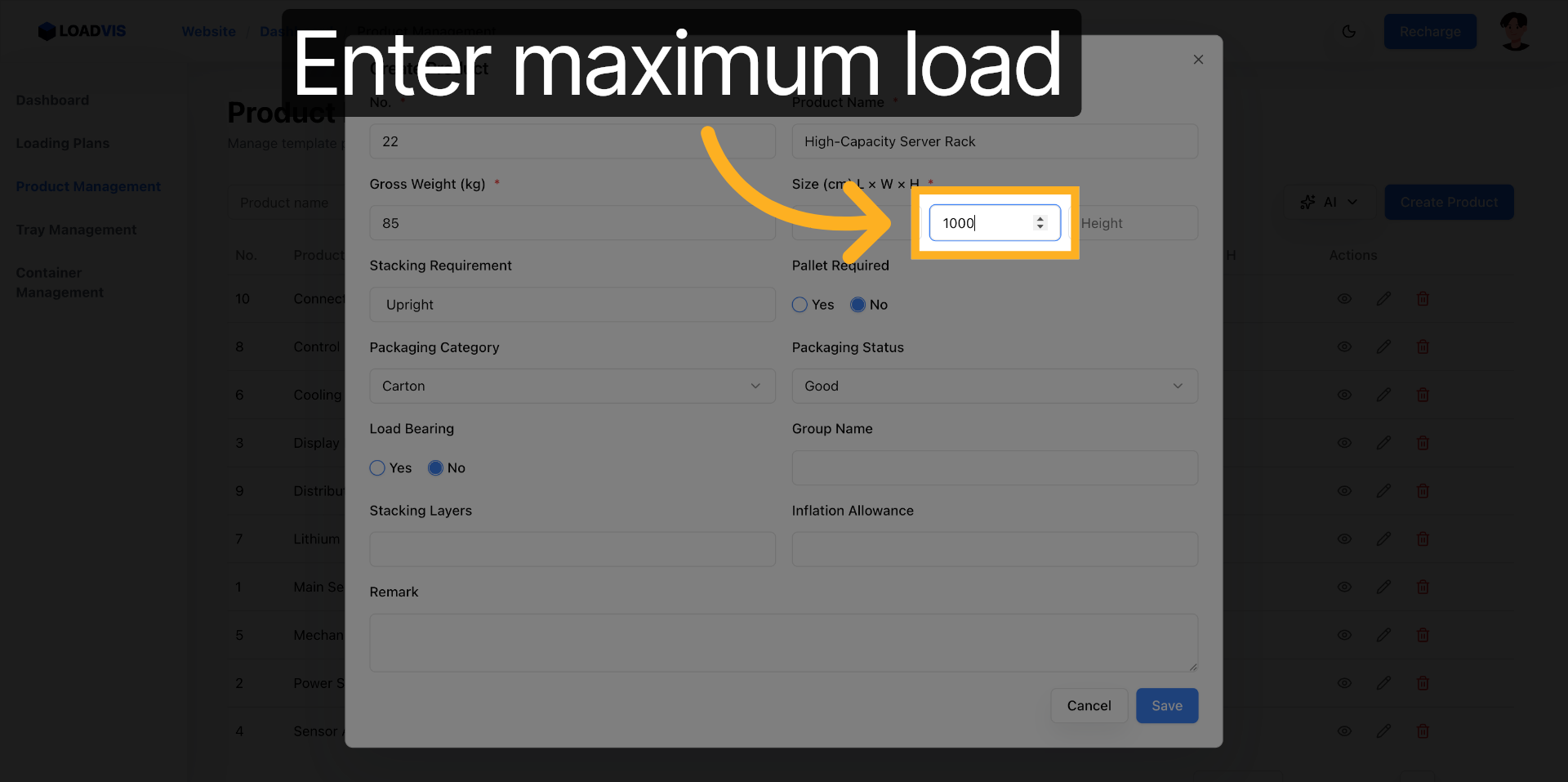
Why do these parameters matter so intensely? Because the load-bearing metric directly dictates the vertical stacking hierarchy the solver will construct. Enable the palletization flag, and the entire base coordinate system undergoes a complete rewrite. Structural overhead enters the calculation matrix. Footprint constraints multiply. Omit these values, and you force the optimization engine to operate under the illusion of infinite rigidity. The direct consequence involves lower-layer compression failures. Unstable center-of-gravity shifts during transit acceleration phases. You cannot outsmart physical stress tolerances with faster data ingestion pipelines.
Wrong path? Trust the parsed output without hesitation. Execute the recognition routine. Attach the generated batch to your loading manifest. Run the solver immediately. You will watch the utilization percentage climb rapidly. Then you will watch the bottom-tier packaging crush. The upper layers become structurally inaccessible. Rework happens. Every single time.

Reliable path demands intentional friction. Treat the AI-generated draft as a structural starting coordinate. Never view it as a finalized execution map. You must systematically carry out cross-verification procedures on the Max Load parameters and Pallet toggles against actual packaging documentation and facility handling protocols. Adjust inflation tolerances to account for real-world strapping variances and cardboard moisture swelling. Only after carrying out this complete audit do you initiate the calculation sequence. The volume metric might drop by one or two percent. But the resulting stowage sequence maintains mechanical stability. It aligns perfectly with forklift operational envelopes. Freight claim frequencies plummet.
Where does the automation actually help? The AI component efficiently bridges unstructured textual dumps into structured database entities. It eliminates repetitive keystroke entry. Standardizes measurement units. Validates dimension formatting syntax. Performs multi-SKU batch ingestion operations without friction.
It stops there. The algorithm cannot physically perceive material fragility. It cannot interpret warehouse racking protocols. It cannot derive weight-bearing thresholds from plain text strings. Human validation remains an absolute mandate for several specific checkpoints:
- Carry out manual cross-referencing of
Max Load Capacityvalues against manufacturer technical sheets or physical scale measurement logs. - Execute the toggling of the
Pallet Requirementparameter based on downstream transport regulations and facility infrastructure constraints. - Carry out adjustment of
Inflationparameters within the edit interface to accommodate packaging swell and strap tension variance.
When things go wrong, it rarely stems from a broken solver. It stems from garbage-in boundary data. You have to carry out the judgment of physical reality yourself. Which steps require manual review? Anything involving structural limits. Anything involving handling equipment clearance. Anything involving weight distribution logic.
AI accelerates the data ingestion pipeline. No doubt. But algorithmic reliability depends entirely on constraint fidelity. Treat parsed geometric dimensions as a starting coordinate. Never treat them as a finished execution plan. Always carry out validation of load-bearing limits and palletization flags before committing to a solver computation run. Execution quality gets determined by the accuracy of your input boundaries. Not by how fast the screen renders the results.