1. SCENARIO & PROBLEM
You carry out volumetric planning. You hit a ninety-six percent fill rate. The dashboard glows with satisfaction.
Then the dock foreman calls. The load is jammed.
What happens on-site rarely mirrors the spreadsheet. The solver treated the shipping unit as a perfect Euclidean box. It completely ignored the physical bottleneck that dictates actual throughput: the rear aperture. You pack based on internal cubic boundaries. You assume a continuous rectangular void. Reality imposes a narrower kinematic funnel. Rigid cargo stacks slide inward. They collide with the door frame. The forklift cannot reverse out. The entire manifest collapses into a logistical standoff.
It is a classic geometric mismatch. The algorithmic model optimized for internal capacity. It failed to perform evaluation of the entry threshold constraint. The pallet fits inside. It will never reach the inside.
2. WHY IT IS UNDERESTIMATED
Teams habitually equate nominal internal LWH measurements with absolute usable volume. It is a convenient fiction. Carrier specification sheets rarely account for structural obstructions. Lock bars. The door swing arc. Minor manufacturing variances in corrugated steel panels. Corrosion-induced deformation over a decade of ocean crossings.
Data entry workflows prioritize velocity over precision. Operators engage in rapid copy-pasting of legacy configuration templates. The aperture constraint gets silently omitted. You fill the length field. You populate the width slot. You leave the door clearance parameter blank or assume parity with the interior roof height. The system accepts it. The mathematical model runs. The output looks mathematically sound.
It is fundamentally broken.
When you treat the container threshold as an abstract concept rather than a rigid physical boundary, you invite catastrophic loading failures. The spreadsheet lies. The warehouse floor does not.
3. KEY OPERATIONS & WHY THEY MATTER
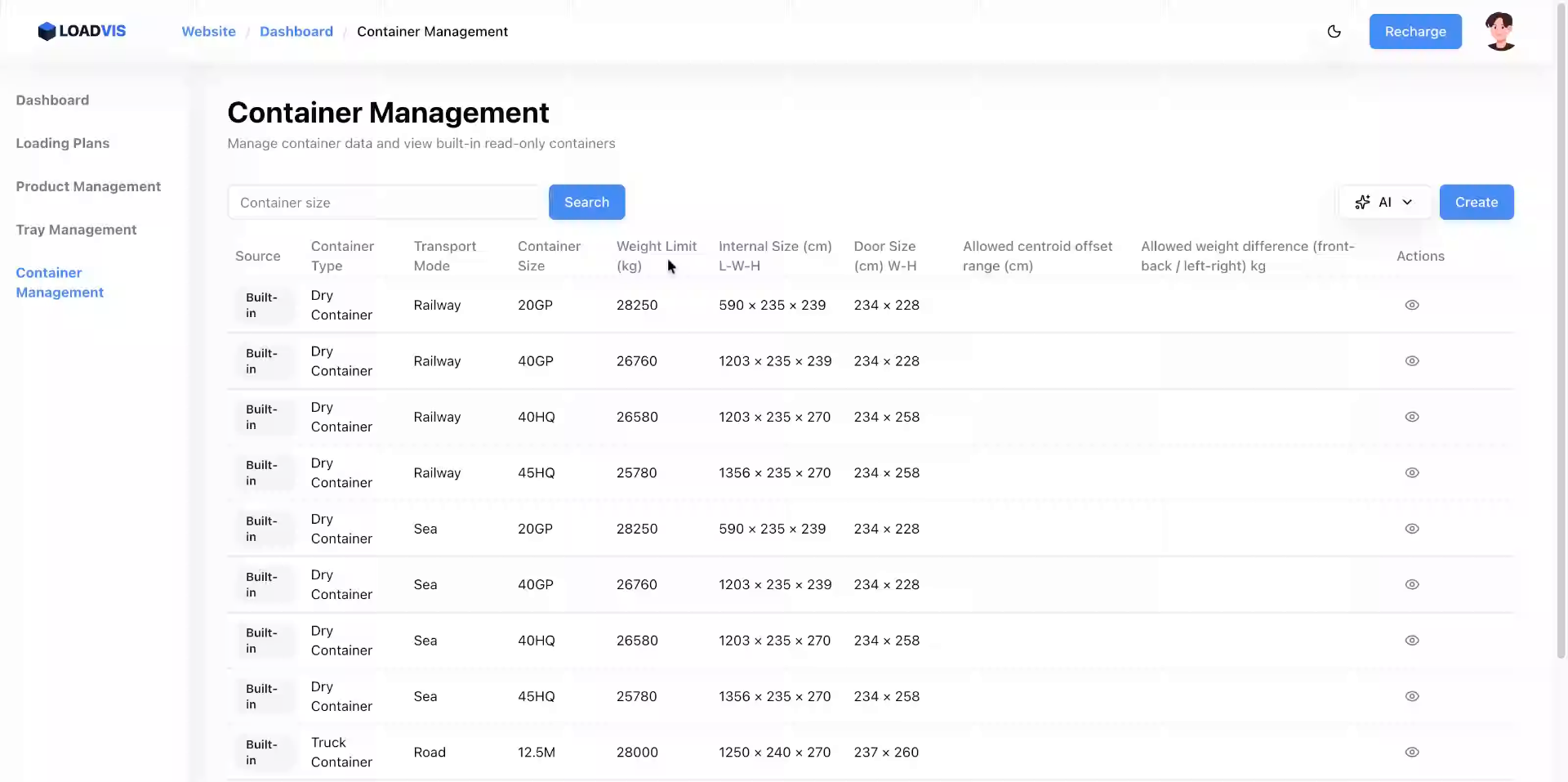
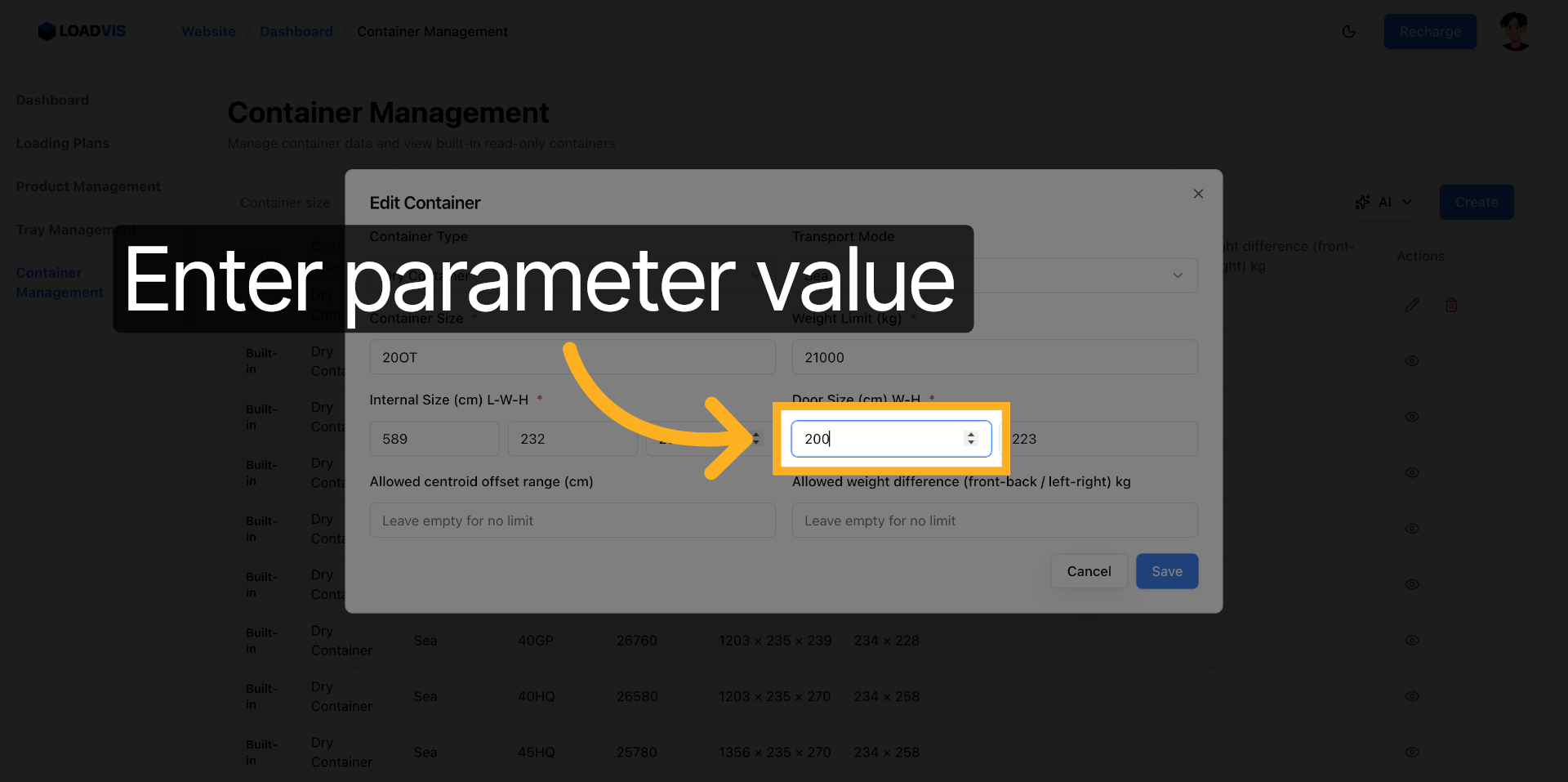
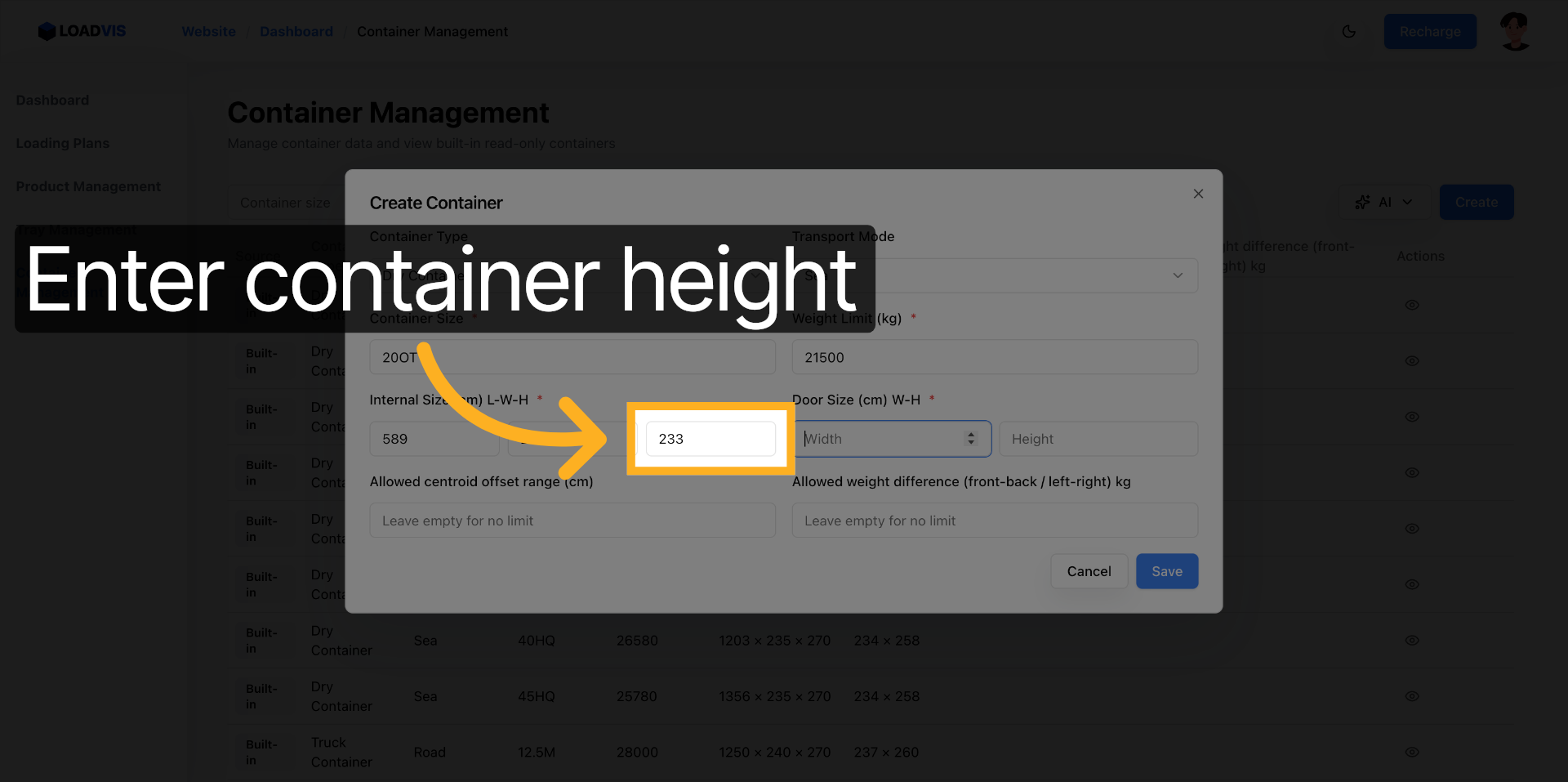
Do not confuse parameter separation with redundant interface design. It establishes the foundational physical constraint that governs spatial topology within the solver. When you initiate the creation workflow or trigger the AI parsing utility, the platform demands distinct numerical inputs for internal clear height and door opening dimensions.
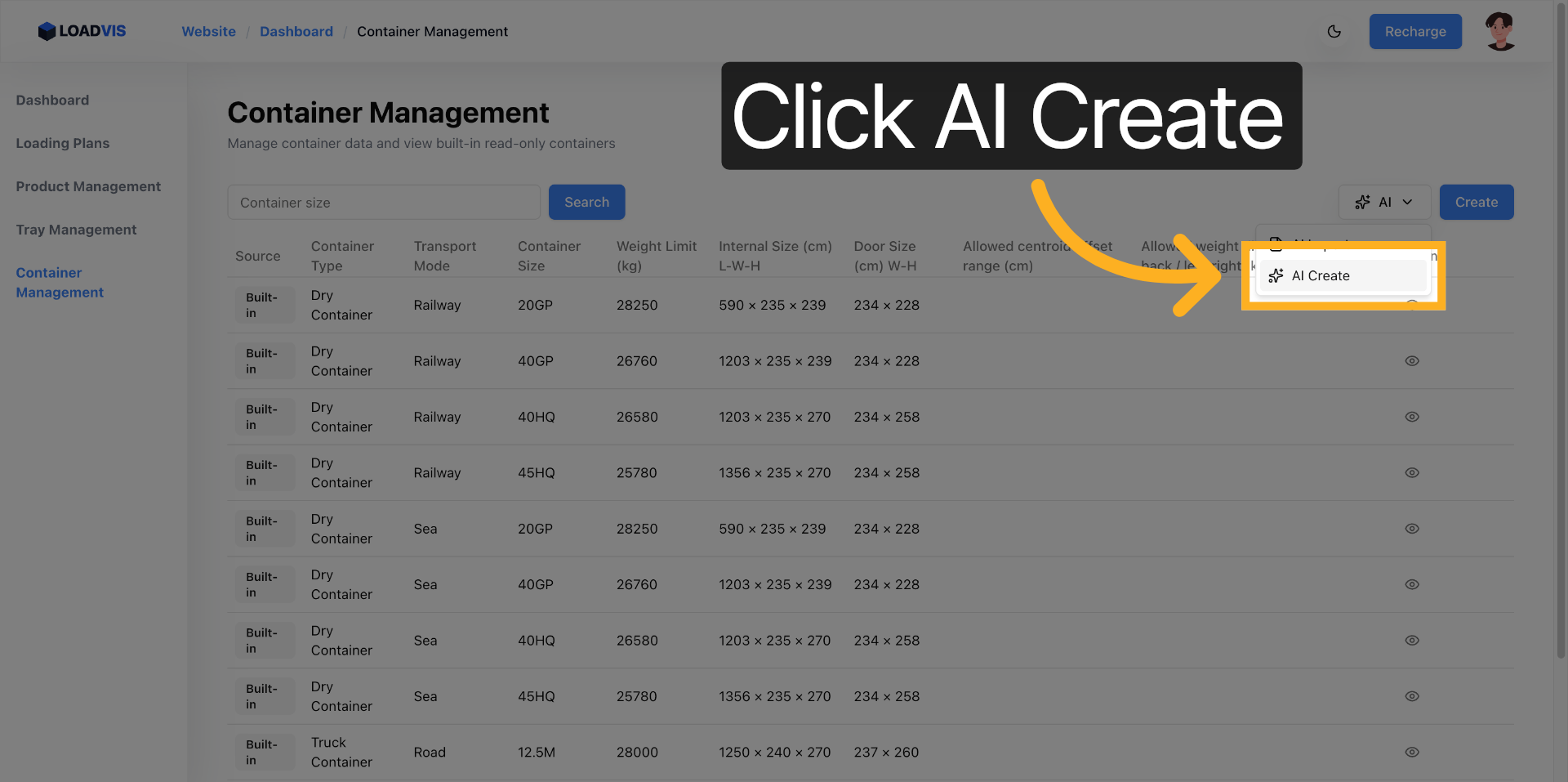
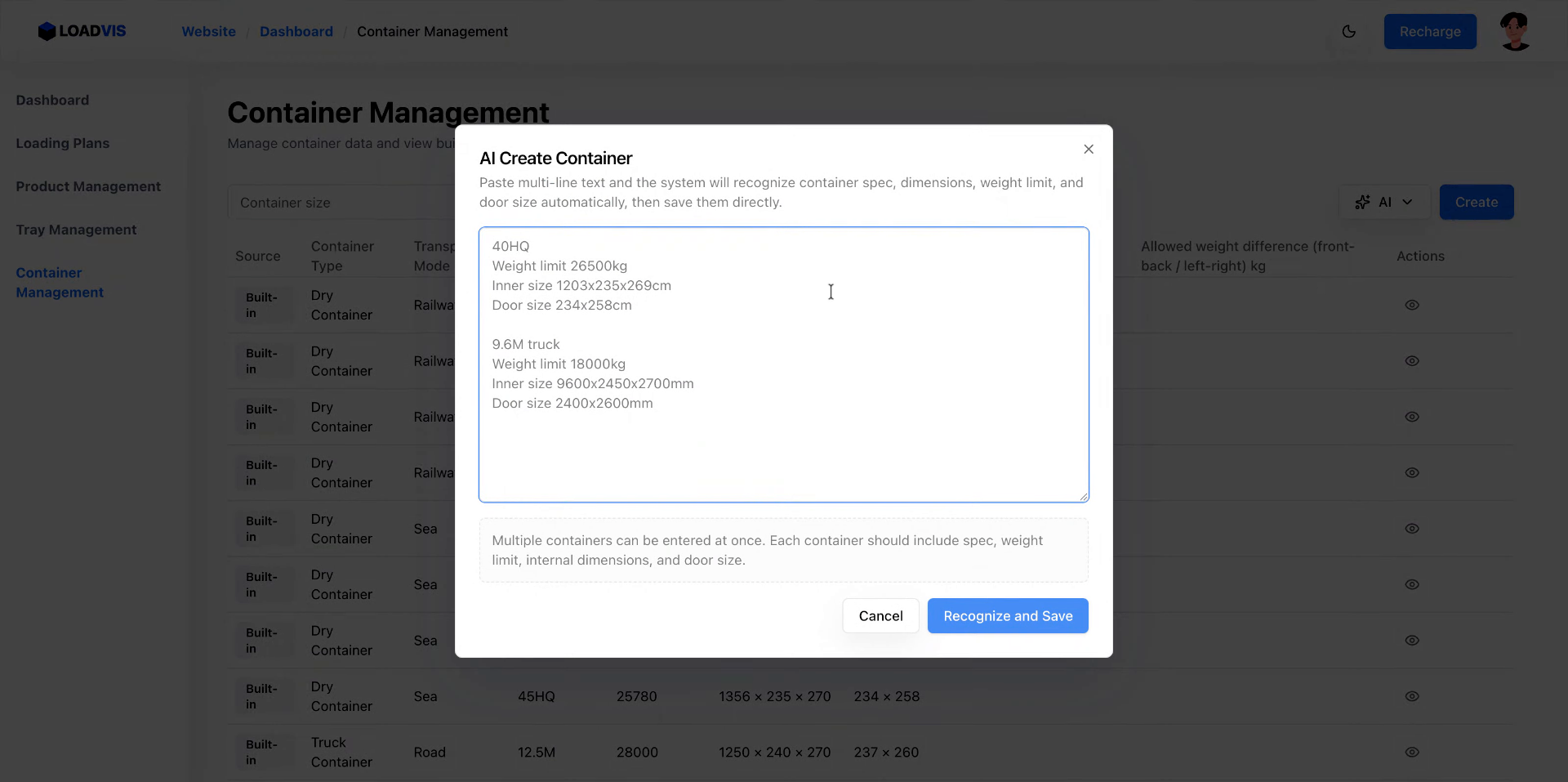
That data modeling distinction carries heavy computational weight. The optimization engine carries out spatial sequencing based on the narrowest entry vector. It engages in clearance validation for top-tier SKUs. It performs geometric impossibility checks before generating a manifest. If the door opening height registers lower than the internal roof clearance, the solver automatically restricts vertical stacking near the rear boundary. It routes taller units forward. It calculates a feasible ingress path.
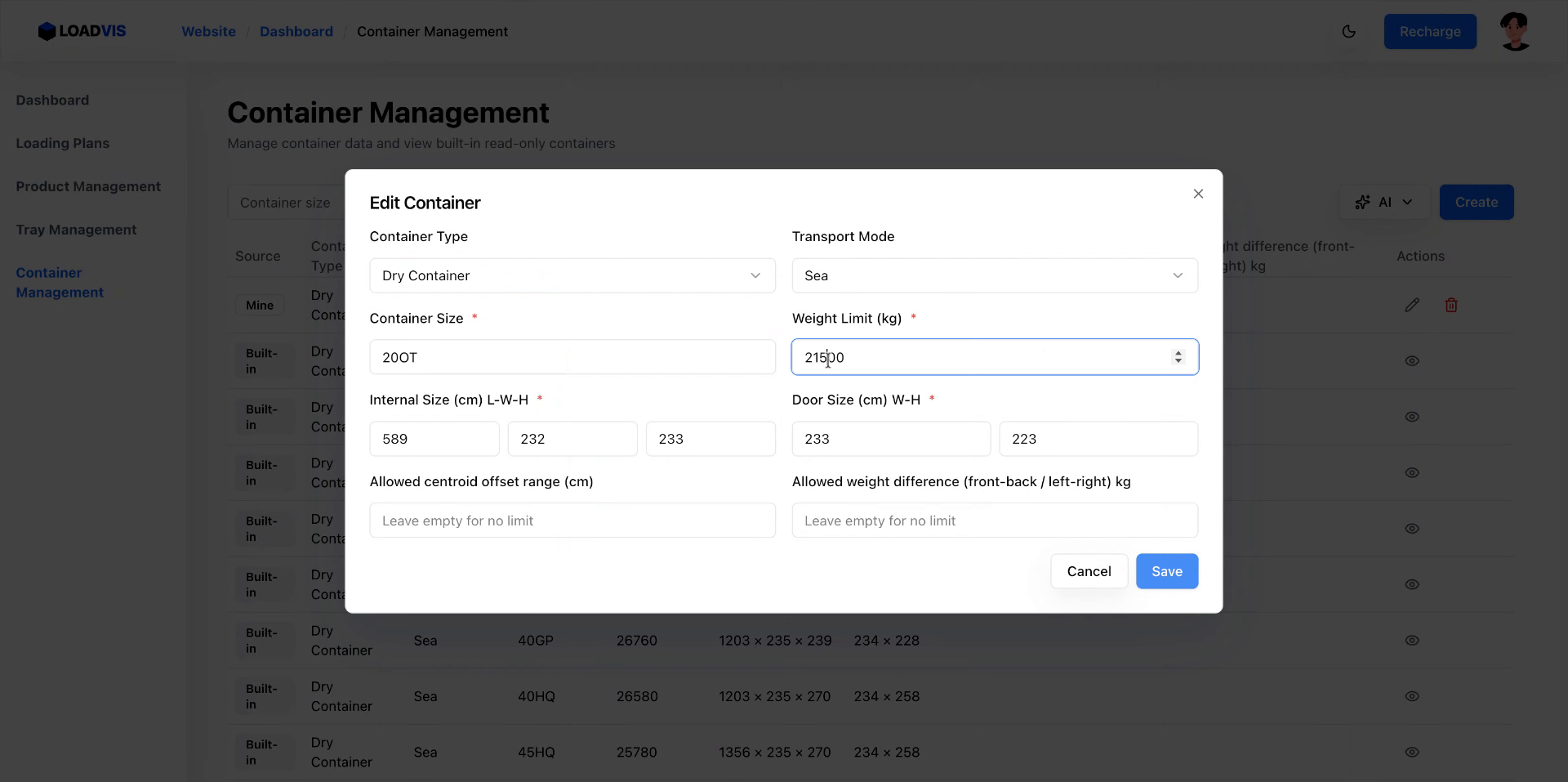
When you engage in the editing process for an existing asset, you carry out direct modification of those clearance fields. You do not merely type numbers. You define a physical gate. The system then carries out persistence of those validated constraints. It recalculates loading permutations. It prevents the algorithmic blind spot that causes dock-side failures.
4. WRONG VS RELIABLE APPROACH
The naive path involves leaving the door aperture fields empty. Or worse, mirroring the internal height value directly into that slot. You tell the solver the entrance equals the interior. The optimization routine happily packs oversized SKUs against the rear wall. It creates an impassable mass. Standard reach-trucks lose their maneuvering envelope. Unloading becomes a manual demolition project.
The reliable workflow requires deliberate parameter input. You must engage in the process of entering verified clearance measurements. When switching operations to non-standard open-top units or heavily worn containers, carry out updates of those specific fields immediately. Do not rely on static manufacturer data for aging fleets.
Treat the AI text parsing utility strictly as an initial drafting layer. It extracts dimensions from raw text rapidly. It does not guarantee physical accuracy. Never skip manual cross-validation of those parsed outputs. Feed verified measurements. The solver responds correctly.
5. TOOL BOUNDARIES & MANUAL CONFIRMATION
The platform enforces strict geometric boundaries during calculation. It carries out automatic persistence of valid configurations. It generates clearance violation warnings when the proposed stack exceeds the defined entry vector.
Yet, it cannot replace on-site physical verification. Software operates on structured inputs. Reality operates on worn hinges and bent frames. You still need to carry out tape measurement comparisons against nominal manufacturer sheets. Verify the door hardware configuration. Does the hinge assembly allow a two-hundred-seventy-degree swing, or does it lock at ninety degrees? Account for internal lock rods. Note protruding rivet lines. Factor in carrier-specific dimensional limits that override standard ISO measurements.
The parsing engine will happily extract a string reading Door Opening: 233×223 cm. Human judgment must carry out cross-referencing of that extracted text against the actual rusted asset sitting in the yard. Only when those values align does the digital model reflect operational reality. The tool flags violations. You must validate the source data.
6. CONCLUSION
Planning accuracy depends entirely on constraint fidelity. Inputting flawed clearance metrics forces the computational engine to optimize a theoretical cardboard construct. It will not solve the physical ingress problem.
Model the actual aperture. Validate the source data manually before committing to the solver. Leave the theoretical box for academic exercises.