When Plans Fail at the Dock: The Hidden Cost of Inaccurate Product Data
1. Scenario & Problem
The dashboard glows green. 94% volumetric utilization. Weight distribution aligns perfectly with axle tolerance bands. You carry out the final validation routine and hit print. Then reality fractures on the warehouse floor.
Bottom cartons buckle under invisible stress. Corrugated walls tear apart. The rear container doors refuse to latch shut because a half-inch pallet clearance discrepancy never made it into the geometric model.
The packing heuristic didn't fail. The math remains mathematically sound. You simply fed the algorithm a structural fiction.
The root cause originates upstream. Buried in stale spreadsheets. Locked inside inaccurate product master data. The system carries out its optimization procedures exactly as instructed. It builds a pristine digital tower on a foundation of phantom constraints.
2. Why It's Underestimated
Operations teams consistently mischaracterize product entry as mundane clerical overhead. They treat it as an administrative checkbox rather than the foundational act of physical constraint definition.
We push for data throughput. Velocity takes precedence over precision. AI batch parsers ingest unstructured supplier PDFs or decaying legacy CSV exports, and they inevitably inherit the semantic ambiguity trapped inside those source files.
The solver operates in a vacuum. It lacks tactile feedback. It possesses zero awareness of warehouse floor dynamics or corrugated yield points. It carries out optimization routines strictly against the numerical values you submit to the database schema.
If the maximum load threshold remains at default null, the packing engine assumes infinite vertical stackability. It will happily generate a seven-tier compression column for fragile electronics.
The system does precisely what you program. Not what the physical cargo requires.
3. Key Operations & Why
We need to pull apart the actual configuration mechanics. Loadvis exposes this through two distinct ingestion pathways, each demanding deliberate oversight.
The AI Creation module executes the automated extraction of gross weight metrics and dimensional vectors from raw natural language text. It strips formatting noise from supplier emails and maps extracted parameters directly into the relational database.
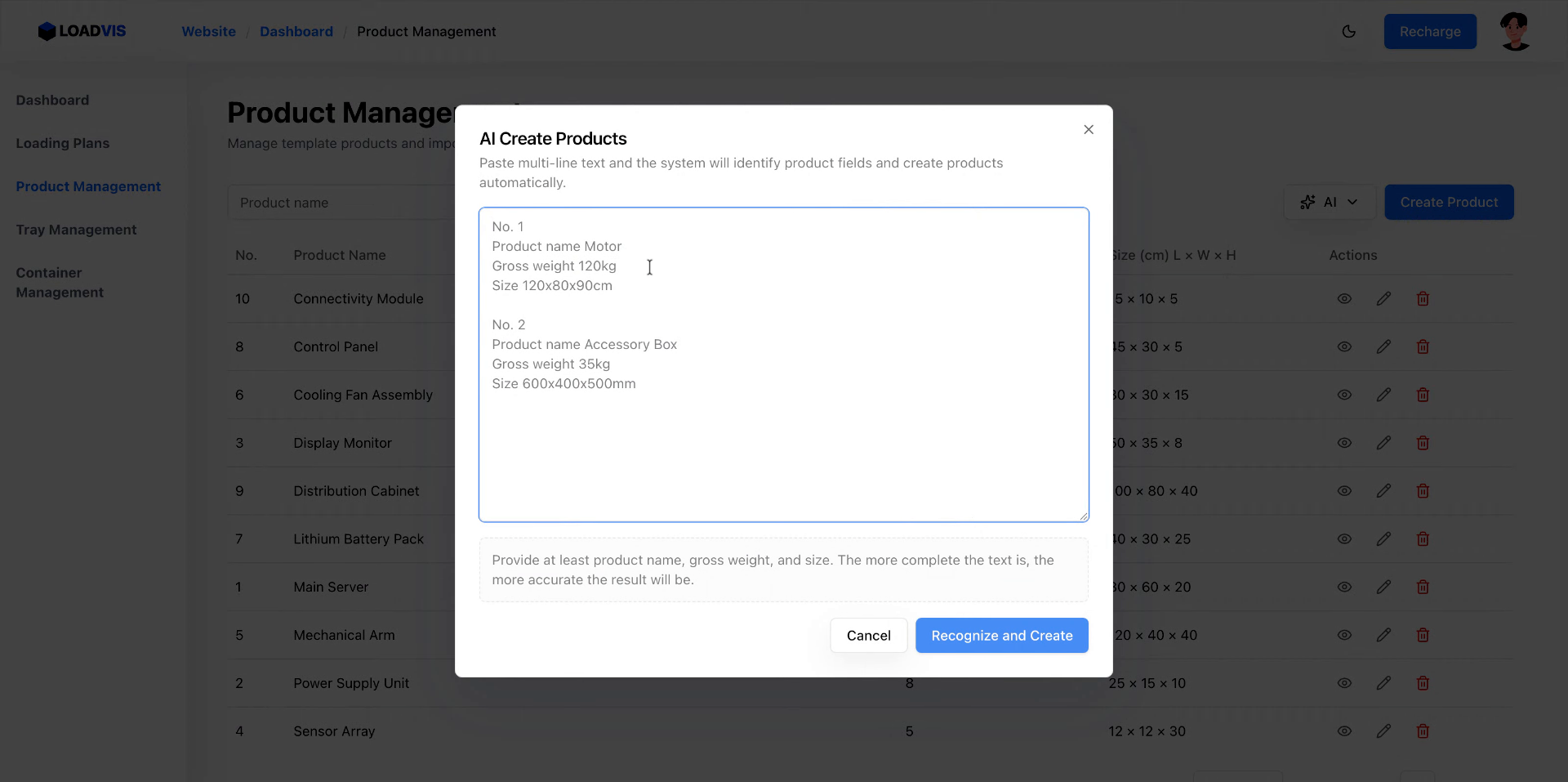
Meanwhile, manual creation workflows demand explicit intervention on specific constraint fields. You must manually trigger the validation gates.
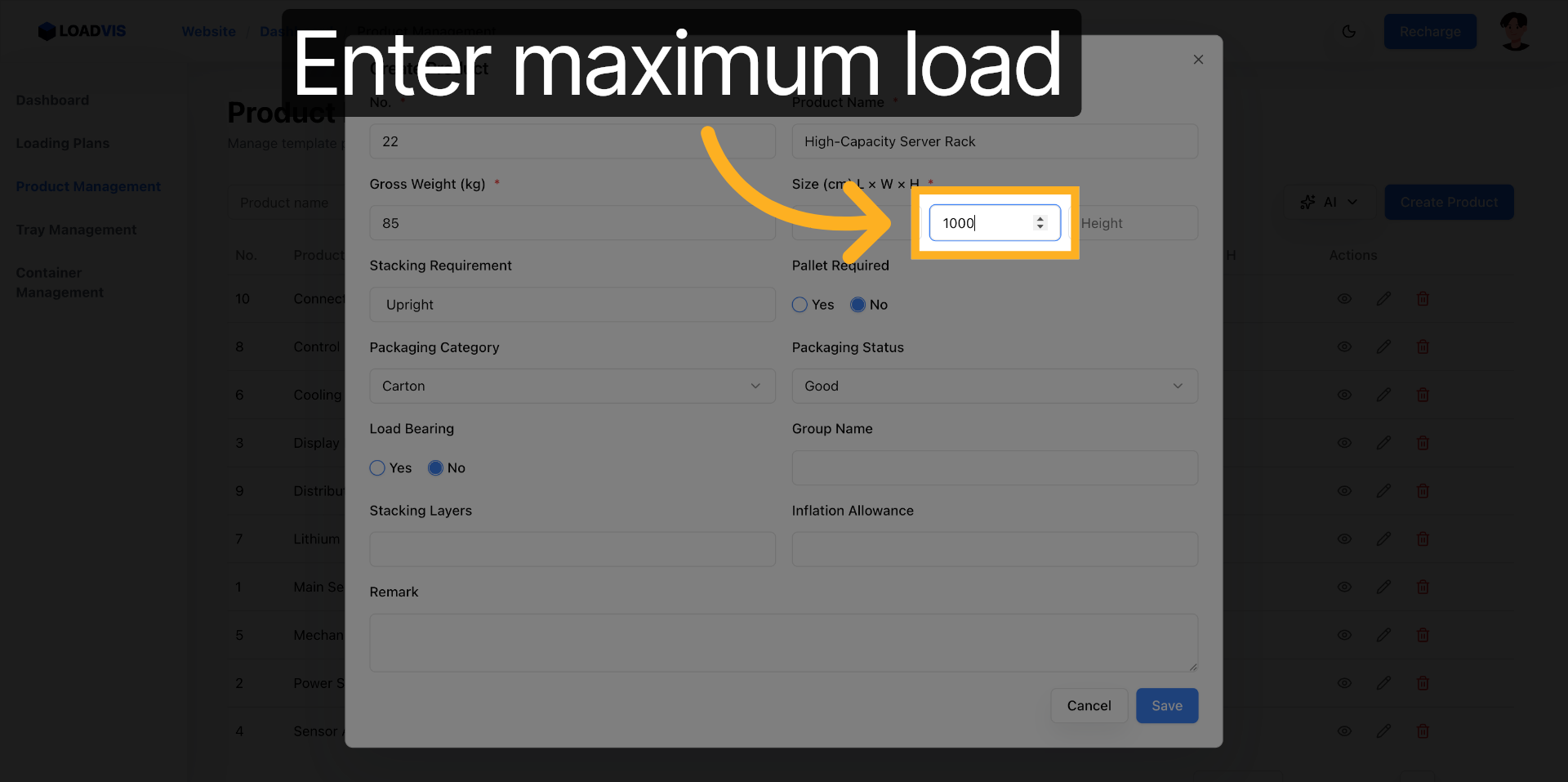
Consider the Maximum Load Capacity parameter. This numerical value dictates the entire vertical stacking hierarchy within the bin-packing solver. It functions as an absolute ceiling for compression forces.
The Pallet Requirement toggle operates differently. Enabling this flag forces the system to carry out automatic dimension inflation and recalculate base-weight distribution matrices. It fundamentally alters the geometric footprint before the algorithm begins arranging cargo units inside the container walls.
Finally, the List Search interface serves a purpose beyond quick lookups. You must employ it as a pre-flight auditing mechanism. Running keyword matches against the master catalog surfaces statistical outliers and unit anomalies before you commit computational cycles to a planning run.
4. Wrong vs Reliable Approach
Let's map the operational divergence.
The flawed execution path looks predictable: auto-import raw text or legacy Excel dumps → accept default field mappings without scrutiny → bypass explicit load capacity threshold configuration → ignore pallet dimension toggles → trigger immediate calculation execution.
The result? Physically impossible stack configurations. Unexecutable 3D loading guide views that collapse the moment a forklift operator makes first contact.
The reliable path requires intentional friction.
Parse the initial payload via AI recognition or structured manual entry. Cross-reference extracted weight matrices and dimensional specifications against verified physical spec sheets from the packaging engineering team. Explicitly define maximum stacking capacity limits that align with actual corrugated grades and structural test reports. Engage the pallet requirement flag exclusively when wooden baseboards or forklift-access skids actively participate in the loading sequence. Utilize the search functionality to conduct systematic outlier audits across the entire catalog.
Only after you carry out these verification procedures should you initiate the final calculation routine.
5. Tool Boundaries & Manual Confirmation
We must draw a hard line around what the software executes and where human oversight remains absolutely mandatory.
The platform excels at structuring chaotic input streams. It enforces strict data type validation across every numeric field. It propagates parameter updates instantly throughout the reusable product library, eliminating version drift.
It cannot perform physical reality verification.
The solver will not detect unit inconsistencies between kilograms and grams, or confuse metric centimeters with imperial inches when you migrate historical records. It carries out no analysis of transit-test fragility or localized crush resistance profiles. Site-specific forklift maneuvering clearances and turning radii fall completely outside its geometric optimization boundaries.
You must carry out manual confirmation procedures against actual packaging specimens, documented warehouse standard operating procedures, or direct supplier confirmation sheets.
If the gross weight field lacks ground-truth verification, the algorithm treats a 15kg variance as absolute physical law. That assumption compounds multiplicatively across forty stacked pallets. You end up with an overloaded container axle or a structurally compromised base layer. The software optimizes the numbers. You own the contextual reality.

6. Summary
Master data accuracy functions as a non-negotiable prerequisite for viable container loading execution. Treat every data entry operation as a deliberate constraint definition exercise rather than administrative overhead. When you align digital parameters with verified physical limitations, the generated planning models survive direct contact with the warehouse floor.