When High Volume Meets Dock Rejection: Why Master Data Precision Dictates Execution Reality
The spatial solver outputs a ninety-two percent cubic utilization metric. The dashboard renders it in crisp, optimistic green. Warehouse staff reject the physical stack within three minutes of the first pallet touching the dock.
Heavy industrial housings sit directly on top of moisture-sensitive corrugated cartons. Unverified length-width-height parameters ignore standard packaging creep, causing a rigid aluminum frame to scrape against the container roof during door closure. The algorithm performed flawless geometry. It failed physics.
We witness this disconnect constantly. Teams treat product registration as administrative data entry rather than foundational constraint modeling. They assume a missing two-centimeter tolerance on a carton or an unset stacking flag represents negligible variance. It is not. Tolerances compound. Minor dimensional drift transforms into structurally unsound column loads. Ignored weight-bearing ceilings trigger bottom-tier crushing. Blocked access routes force manual re-palletization. The screen promises volume efficiency. The floor delivers kinetic rejection. Master data must bridge digital abstraction and physical ground truth. Otherwise, the optimization engine merely calculates elegant failures faster.
Why Product Entry Gets Downgraded to Clerical Work
Most logistics teams operate under a persistent cognitive trap. They assume master data configuration belongs to the procurement clerk, not the operations architect. The belief holds that slight parameter deviations will only marginally adjust the solver’s spatial output. That assumption collapses under real-world stacking dynamics. A solver does not intuitively understand that a polymer-wrapped electronics pallet cannot sustain three metric tons of downward pressure. It only reads numerical boundaries. If those boundaries remain blank or inherit platform defaults, the mathematical model assumes infinite compressive strength. You end up with a theoretically optimal load that physically implodes.
The misalignment stems from treating dimensional and weight fields as static descriptors. They are actually dynamic behavioral triggers for the algorithm. When you carry out the process of recording a gross weight, you are defining gravity constraints. When you engage in the action of toggling a palletization requirement, you are rewriting the spatial footprint logic. The system does not guess. It executes.
Mapping Operations to Constraint Reality
Let us trace the actual workflow and observe how parameter injection dictates execution behavior. We begin by initiating a directional selection process to locate the product management interface. The interface serves as the primary ingestion point for all subsequent solver inputs.

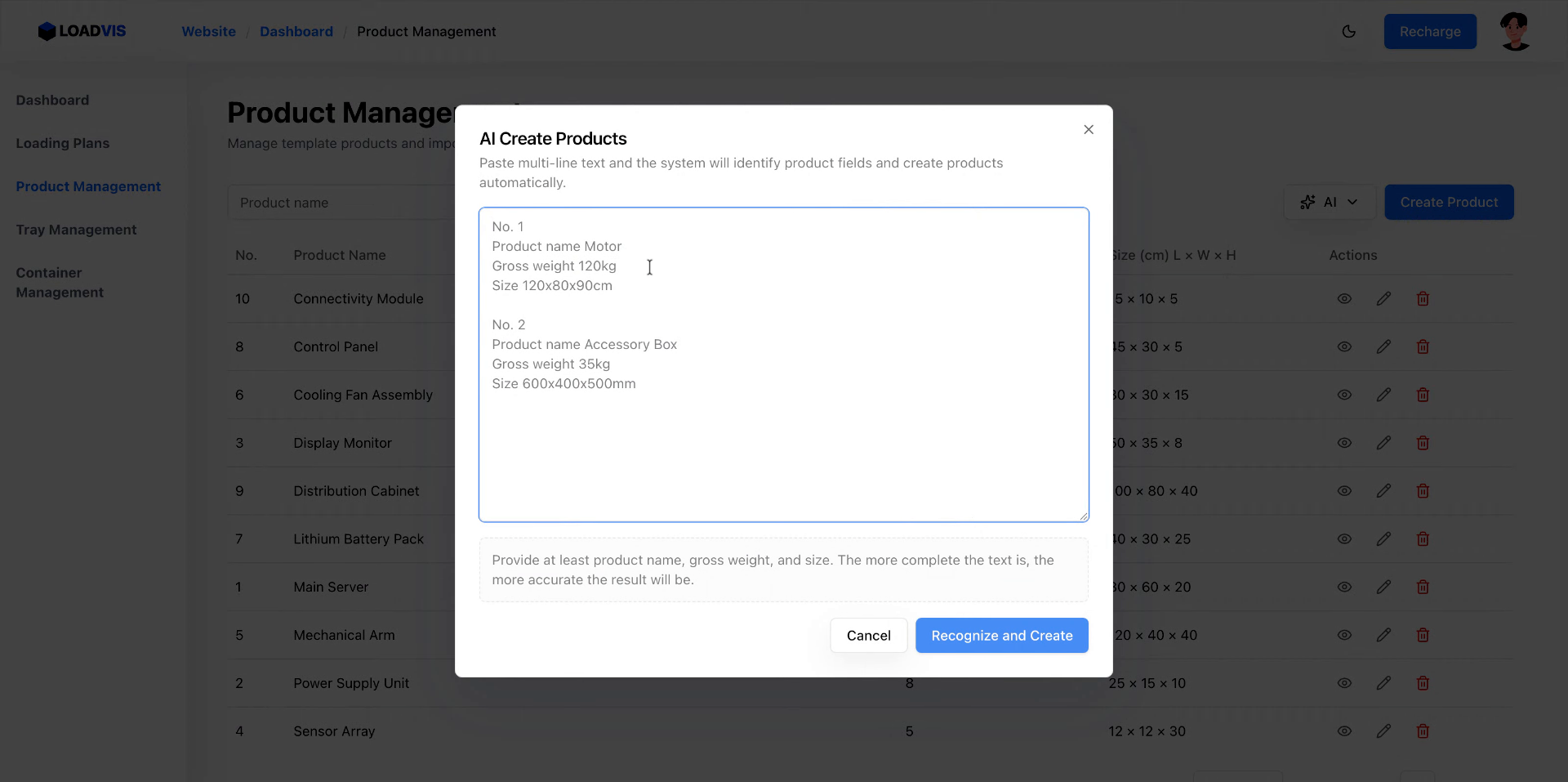
Instead of manual row-by-row typing, teams frequently carry out the execution of natural language parsing to accelerate draft generation. You perform the action of inputting unstructured specification text into the designated recognition field. The parsing engine extracts gross weight, nominal dimensions, and base identifiers simultaneously. You can submit multiple entries by executing the process of separating individual product blocks with empty line breaks. The system translates linguistic chaos into structured database records. Speed matters here. But speed never substitutes for verification.


Once the draft exists, we carry out the process of engaging with the parameter editing layer. This is where theoretical geometry meets operational safety limits. You initiate a selection action upon the edit control. The system grants write permissions to every constraint field. Pay attention to the mechanics behind each value.
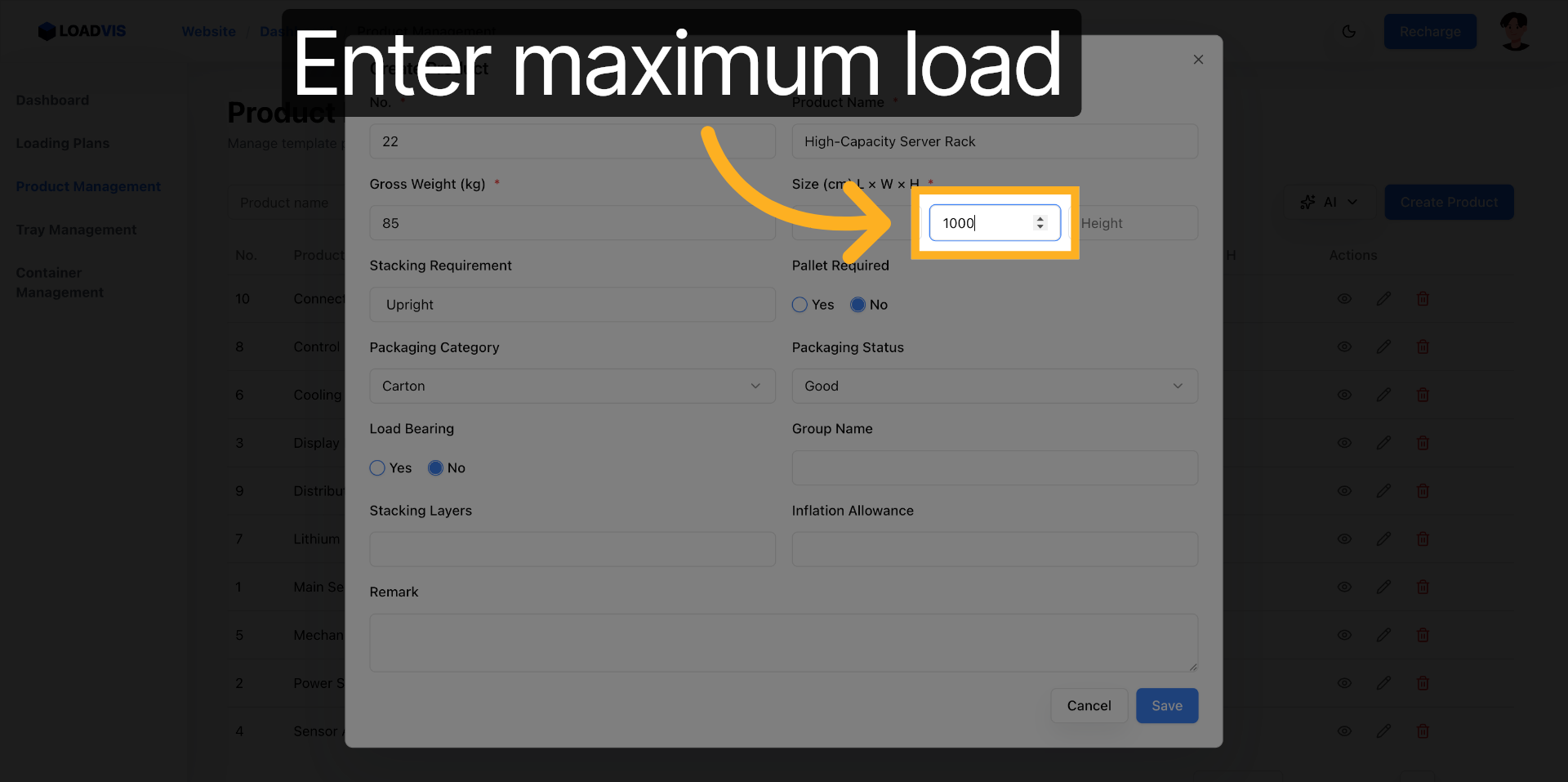
Maximum Load Capacity acts as the ceiling for downward stacking force. You perform the input of a numerical threshold, perhaps one thousand kilograms. When you engage in the configuration of this parameter, the solver enforces a hard stop. It will no longer place heavier cargo atop that specific SKU. The field dictates structural survival.
Minimum Load Capacity establishes a floor constraint. You carry out the transcription of a baseline requirement, say two hundred kilograms. The algorithm understands it must group sufficient adjacent units before committing that SKU to the spatial layout. It prevents isolated placement that would waste volumetric capacity.
Pallet Requirement toggles the spatial algorithm from raw Cartesian stacking to footprint-aware placement. You execute the selection process upon the affirmative control. The engine immediately incorporates standardized tray dimensions and additional base weight into the calculation matrix. It stops treating the product as a floating brick. It begins treating it as a logistics-ready module.

Inflation or Packaging Adjustment bridges nominal factory dimensions and realized shipping profiles. Corrugated sides bulge. Stretch wrap adds radial thickness. You engage in the process of updating the length and width vectors to account for this expansion. Without it, your calculated clearance assumes a vacuum environment. Physical reality does not.
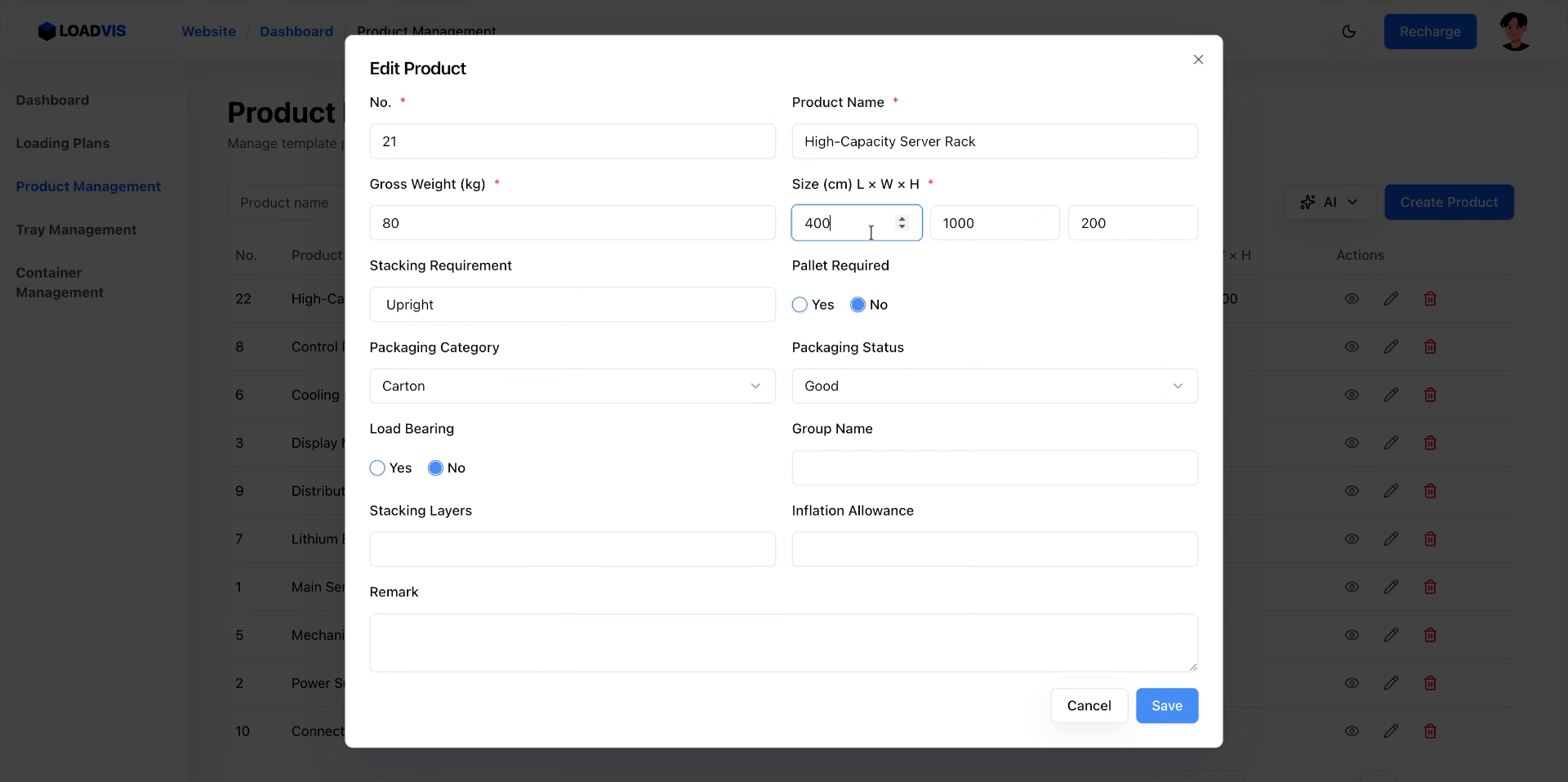
You finalize the operation by executing the validation sequence. The system persists the revised constraints. The list refreshes. The solver now possesses corrected physical laws.
Contrasting Execution Pathways
The common failure pattern follows a predictable decay. Teams execute the process of bulk AI generation or direct Excel import. They bypass systematic auditing. They accept default numerical values without cross-referencing physical manifests. They trigger the calculation engine immediately. The output looks clean. It fails upon loading.
The reliable pathway demands deliberate friction. You execute the process of drafting via AI or spreadsheet ingestion. You then initiate a methodical audit cycle focusing exclusively on constraint fields. You cross-reference nominal specifications against measured warehouse samples. You toggle palletization logic to mirror actual floor workflows. You verify unit consistency across weight and dimension inputs. You confirm stacking thresholds for top-heavy assemblies. Only after these manual checkpoints do you carry out the execution of the save command and proceed to the solver.
Judgment criteria remain straightforward. Verify that gross weight matches scale measurements, not catalog estimates. Confirm that maximum load reflects the weakest structural layer, not the strongest. Enable pallet mode when the receiving facility enforces standardized tray handling. Disable it when bulk floor loading dominates. The solver does not penalize accuracy. It penalizes omission.
Tool Boundaries and Ground Truth Validation
We must define precisely where the platform assists and where human intervention remains mandatory. The system carries out the execution of unstructured text extraction, field normalization, and batch entry acceleration. It handles mathematical spatial packing efficiently. It does not measure cardboard compression rates. It cannot infer real-world forklift clearance tolerances. It does not possess visibility into customer-specific handling mandates or seasonal packaging inflation trends.
When physical weight deviations occur, you must perform the verification manually. When packaging suppliers alter cardboard flute density, you must update the inflation values. When warehouse floor equipment requires wider turning radii, you must reflect that constraint in your footprint logic. The tool executes geometry. Operators validate ground truth. Relying on automated defaults for physical parameters guarantees algorithmic success paired with physical rejection.
Data readiness precedes algorithmic optimization. Always. Configure constraints as physical laws, not descriptive notes. Verify dimensions against calipers and scales. Treat stacking limits as structural engineering boundaries, not suggestions. The solver will only deliver executable reality when the input reflects actual material behavior.